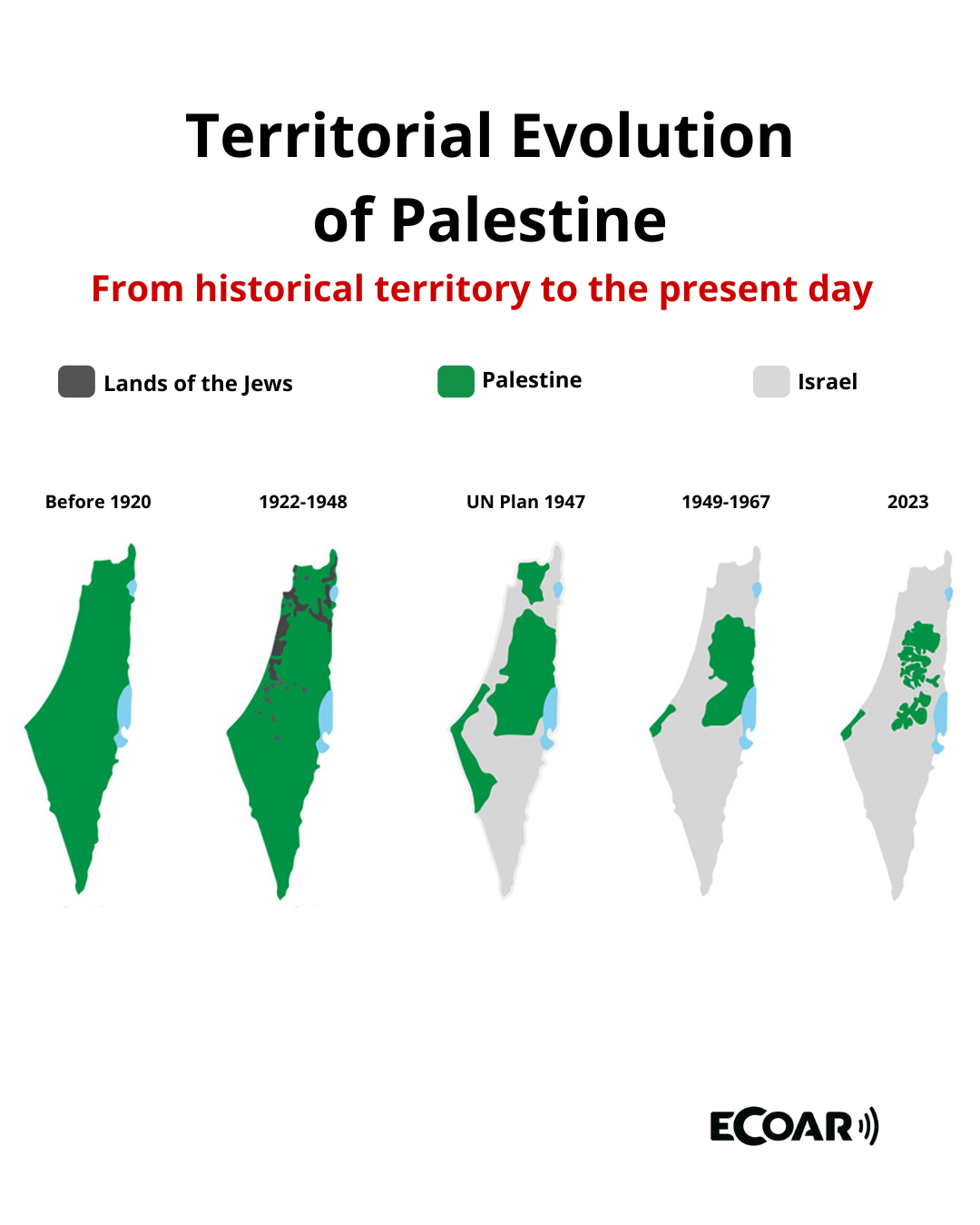
The ethnic cleansing of Palestinian people began in 1948 with the Nakba (“catastrophe” in Arabic), when Zionist forces displaced 750,000 people and destroyed 530 villages. Data from Israeli archives (such as the State Archives of Israel) show that this process of expulsion and ethnic cleansing was systematically planned. Today, less than 20% of the historic Palestinian territory prior to 1948 belongs to its people (with comparative sources showing that the reduction in Palestinian territory is as high as 94% (compared to 1946) in the current West Bank and Gaza under military occupation).
The founding myths of the Israeli state were based on three false narratives: the idea of “a land without a people for a people without a land,” denying the secular Arab presence; the supposed legality of the UN territorial partition in 1947—rejected by Arab countries for ignoring demographic rights; and the narrative of a “defensive war” in 1948, which is contradicted by the Dalet Plan, which predates that “defensive war” and ordered the expulsion of civilians, the occupation of Palestinian towns and cities, and the destruction of villages to prevent return and ensure total control of strategic areas.
The current occupation follows colonial patterns identified by the UN (ESCWA/2017 report): expansion of illegal settlements (more than 700,000 settlers in the West Bank), apartheid (there are hundreds of discriminatory regulations with more than 65 direct discriminatory laws), and structural violence. Gaza has been under blockade since 2007, with child malnutrition rates similar to those in areas of open warfare.
Israeli policies clearly meet the indicators of genocide: murder and physical destruction (more than 35,000 Palestinians killed from 2008 to 2023 and more than 70,000 Palestinians since October 7, 2023. To this must be added the more than 400 killed by Israel since the 2025 “ceasefire”); serious harm to physical or mental integrity (torture, extreme psychological violence, etc.); subjection to living conditions that seek total or partial physical destruction (80% of the population depends on humanitarian aid, 97% of the water is undrinkable, more than 65,000 homes and infrastructure have been destroyed in Palestine since 2000); as well as forced displacement (in addition to the 750,000 Palestinians displaced in 1948 (Nakba), there is a continuous flow of displacement, with 2024 and 2025 being record years, as there are almost 2 million people in each of these periods. The Palestinian people have 6 million refugees scattered throughout the world).
Israel’s construction of a victim narrative seeking to justify its genocidal and colonial process against the Palestinian people has broken down in recent years, in favor of a movement of international solidarity with the Palestinian resistance movement that is beginning to bear fruit (international boycotts of sporting and social events, popular food distribution committees, international arrest warrant against Netanyahu for war crimes and crimes against humanity, etc.).