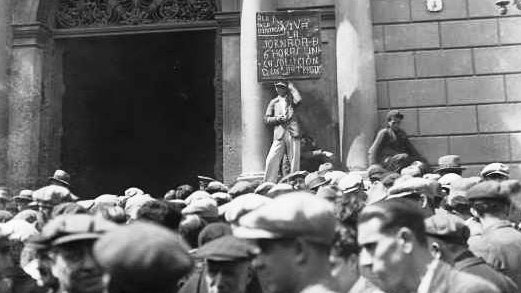
The housing crisis is not a new phenomenon. In the summer of 1931, barely three months after the proclamation of the Second Republic, Barcelona witnessed the first major rent strike in the history of the Spanish State. More than 100,000 working-class families, newly arrived in the migratory wave attracted by the 1929 International Exhibition, decided to stop paying rent due to the impossibility of coping with abusive increases and the lack of work resulting from the ’29 Crash. In neighborhoods such as Barceloneta, Sants, El Clot, or the ‘casas baratas’ (low-cost housing) of Bon Pastor and Can Peguera, the protest spread like wildfire.
Behind the mobilization was the ‘Comité de Defensa Económica’ (Economic Defense Committee) , promoted by the construction union of the ‘Confederación Nacional del Trabajo’ (CNT) (National Confederation of Labor). Their central demand was clear: a 40% reduction in rents and the forgiveness of payment for unemployed people. The organization functioned from the grassroots, with neighborhood assemblies and a strategy of community solidarity that included active resistance to evictions: when the police threw furniture into the street, the neighbors would carry it back up to the homes. Women, managers of the household economy, played a fundamental role on the front lines of the protests and in building mutual support networks.
The strike lasted between July and December of that year, coinciding with the ‘Telefónica’ strike and a general strike in September. The response from the new republican authorities, who were supposed to represent hope for change, was harshly repressive. The government of Manuel Azaña and the Generalitat of Francesc Macià sent the ‘guardia de asalto’ (assault guard), who charged at demonstrations and made hundreds of arrests. According to sources, the clashes resulted in 18 deaths and dozens of injuries. The entire organizing committee was imprisoned at the end of the year.
Although repression managed to halt the movement, the strike was not a defeat. Families saved millions of pesetas during those months, and in January 1932, many small landlords were forced to negotiate reductions to win back their tenants. The movement set a fundamental precedent, continuing intermittently throughout the Republic and becoming a historical reference for subsequent neighborhood struggles for the right to decent housing. Today, almost a century later, its memory returns to the assemblies and the demands of tenants’ unions.
📸 Plaça de Sant Jaume during the tenants’ strike of 1931