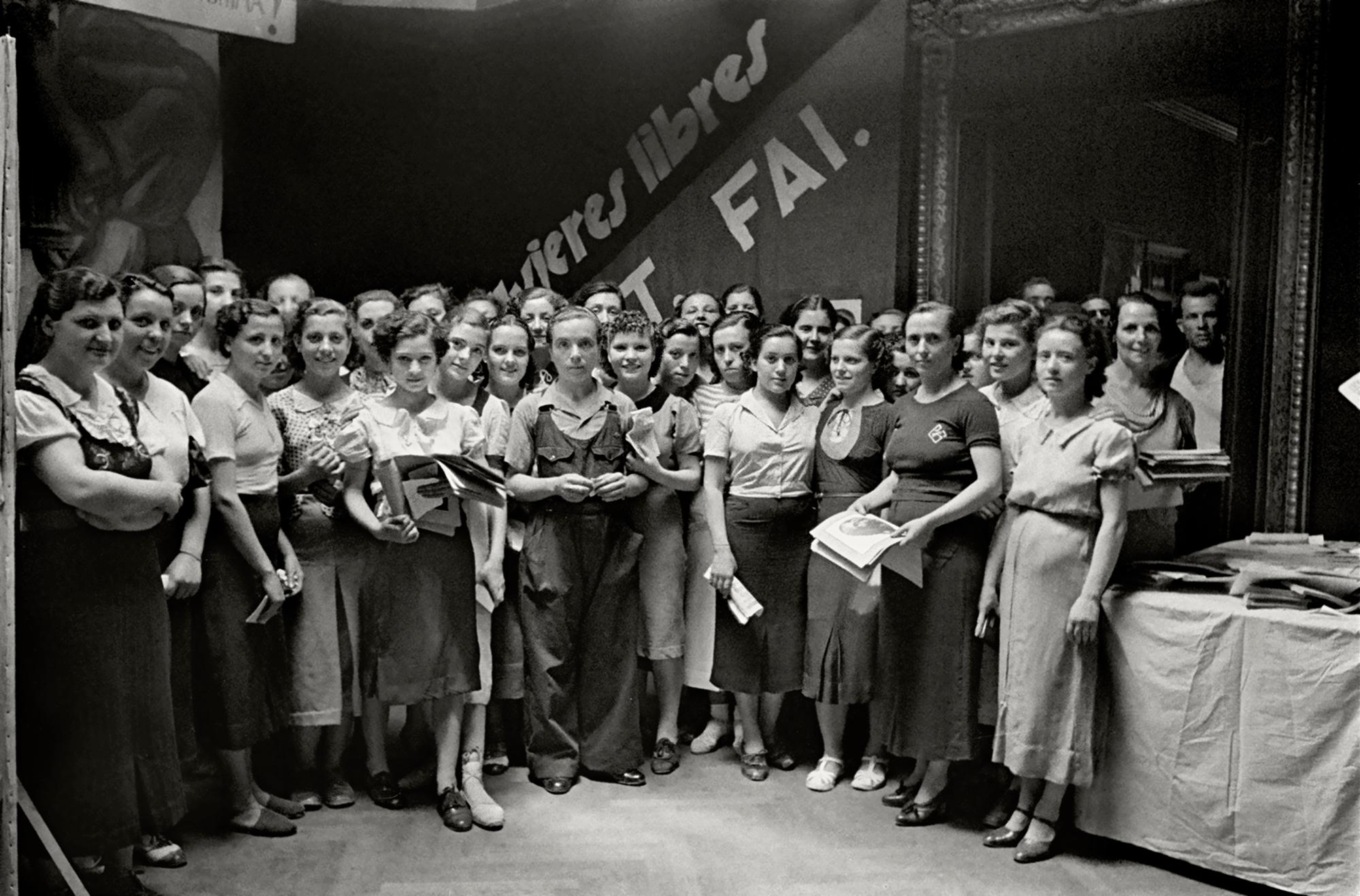
In the context of the Second Republic and the Civil War in the Spanish State, an organization emerged that marked a milestone in the history of working-class feminism. “Mujeres Libres” (Free Women), founded in 1936, was not simply a women’s group within anarchism, but an autonomous organization that fought for a double emancipation: social and gender. Its members, aware that the revolution would not automatically end the subordination of women, confronted what they called the “triple enslavement”: that of ignorance, that of the condition of being a woman, and that of labor exploitation.
To break the first chain, that of ignorance, “Mujeres Libres” developed intense educational work and technical training. The organization understood that training was the fundamental tool for women to become self-sufficient and participate equally in society. They created literacy schools, traveling libraries, and, in a pioneering move, taught courses in mechanics, electricity, and driving, trades traditionally reserved for men. This work not only sought professional qualification but also aimed for women to “recognize and act upon their own capabilities,” becoming active subjects of their own lives.
Participation in the labor movement and solidarity were the other pillars of their struggle. Despite resistance from some sectors of the libertarian movement, “Mujeres Libres” integrated into the CNT and organized women into specific unions, such as the Women’s Emancipation Union in Jerez, which enlisted around 1,500 domestic and textile workers. In times of war, their solidarity materialized in the creation of nurseries and children’s colonies to care for the sons and daughters of those fighting at the front or those who had died, such as the well-known “Espartaco” Colony in Argentona, where a pedagogy based on freedom and mutual support was applied.
Behind this project were women whose life trajectories deserve to be rescued from oblivion. Figures like the poet Lucía Sánchez Saornil, the doctor Amparo Poch i Gascón, or the union activist María Luisa Cobo were role models who challenged established roles. Their story, cut short by the Francoist victory and subsequent exile, demonstrates that historical memory is also “feminist memory.” “Mujeres Libres” left a fundamental legacy for later feminisms by showing that class struggle and women’s struggle are inseparable and that, as one of its militants wrote, even with “truncated wings,” the emancipatory experience is “an invaluable treasure.”
📸 National Congress of the Free Women’s Federation 1937.