
Today, June 17, the 52nd G7 summit comes to an end in Évian-les-Bains (France). The G7 is an annual meeting of the leaders of the main Western powers aligned with the defence of neoliberalism.
Once again, the G7 highlights the unequal architecture of global power. The forum is made up of Germany, Canada, the United States, France, Italy, Japan and the United Kingdom, with the European Union as a permanent participant. Although it is not formally an institution with the authority to approve binding resolutions, its decisions shape the global economy and international politics.
The origins of the group date back to the 1973 oil crisis and the collapse of the “Bretton Woods” system. In 1975, the first summit was held in Rambouillet (France). Canada joined in 1976, and Russia entered in 1998, forming the G8, until it was expelled in 2014 following the annexation of Crimea.
Although the G7 presents itself as a tool to address the world’s major crises, the reality is that these powers meet to strengthen the defence of their interests and the current “status quo”. Proof of this is that, despite representing barely 10% of the world’s population, the member countries concentrate a far greater share of global GDP and financial wealth, revealing the enormous power asymmetry that exists at the international level. This disparity fuels criticism regarding the group’s legitimacy, as a small number of countries determine trade, financial and debt policies that affect the entire planet.
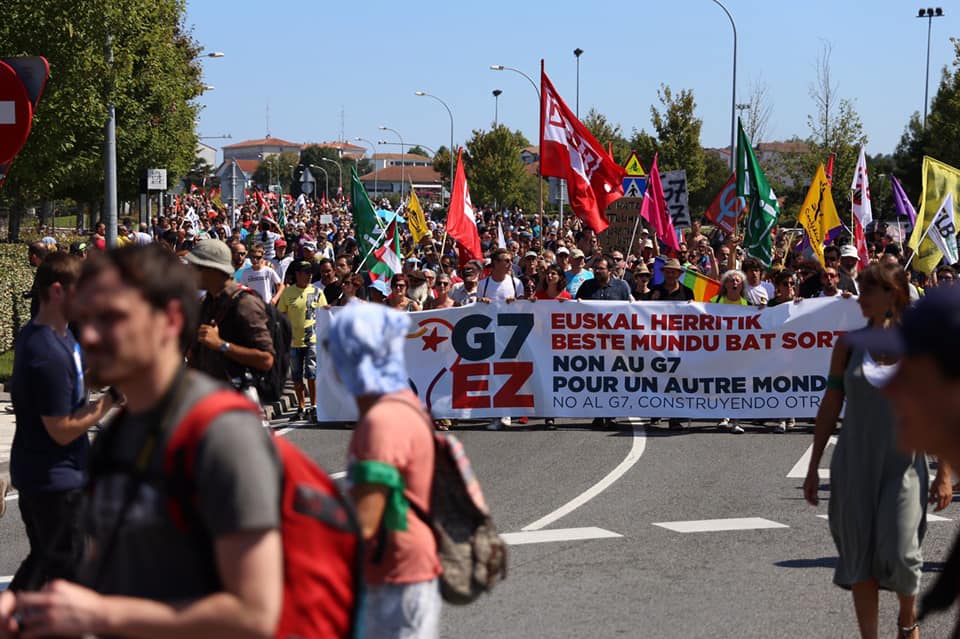
For more than two decades, social movements have organised counter-summits to denounce the economic model promoted by the G7. Following the rise of the anti-globalisation movement in the 1990s, numerous international organisations began convening these alternative spaces to denounce a system that favours major powers and transnational corporations over wealth redistribution and the protection of the planet.
The success of these counter-summits led to a significant increase in police presence and restrictions on freedom of movement during the events. This resulted in systematic violations of the right to protest, arbitrary arrests and episodes of disproportionate police violence, as occurred in Genoa (Italy) in 2001 and in Biarritz (Basque Country) in 2019. Another recent example was the ban on large demonstrations in Geneva during June 2026.
Counter-summits represent the opposition of social movements, trade unions and environmental groups to the perpetuation of an unjust economic system. Their demands include divestment from fossil fuels, fair taxation of multinational corporations and an end to the impunity with which transnational companies operate globally.
References:
La Haine (2019). Llamamiento a la movilización contra el G7 y su mundo. https://eh.lahaine.org/llamamiento-a-la-movilizacion-contra
Deutschland.de (2022). ¿Qué países pertenecen al G7? https://www.deutschland.de/es/miembros-del-g7-datos-cifras-y-hechos
Ecoar Global (2026). Seattle ’99: O Berro de Desobediencia co que naceu o Movemento Antiglobalización. https://enaccion.ecoarglobal.org/gl/2026/01/12/seattle-99-o-berro-de-desobediencia-co-que-naceu-o-movemento-antiglobalizacion/
Rage Climatique. A short history of anti-capitalist counter-summits. https://www.rageclimatique.org/en/article-du-journal/a-short-history-of-anti-capitalist-counter-summits
El Salto. Más de 14.000 efectivos policiales, dificultades a la prensa y detenciones aleatorias en el G7. https://www.elsaltodiario.com/movimiento-antiglobalizacion/14000-efectivos-policiales-dificultades-prensa-detenciones-aleatorias-g7#
Wikipedia (2026). 27th G8 summit. https://en.wikipedia.org/w/index.php?title=27th_G8_summit&oldid=1329457799
Cuarta Internacional (2026). Movilización contra el G7 los días 13 y 14 de junio de 2026. https://fourth.international/index.php/es/comite-internacional/940/europa/754
24 (2026). Genève interdit les grandes manifestations en juin à cause du G7. https://www.24heures.ch/g7-2026-geneve-interdit-les-grandes-manifestations-en-juin-404895345708