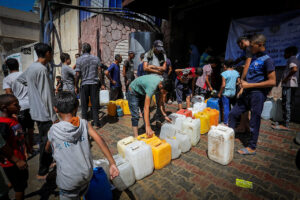
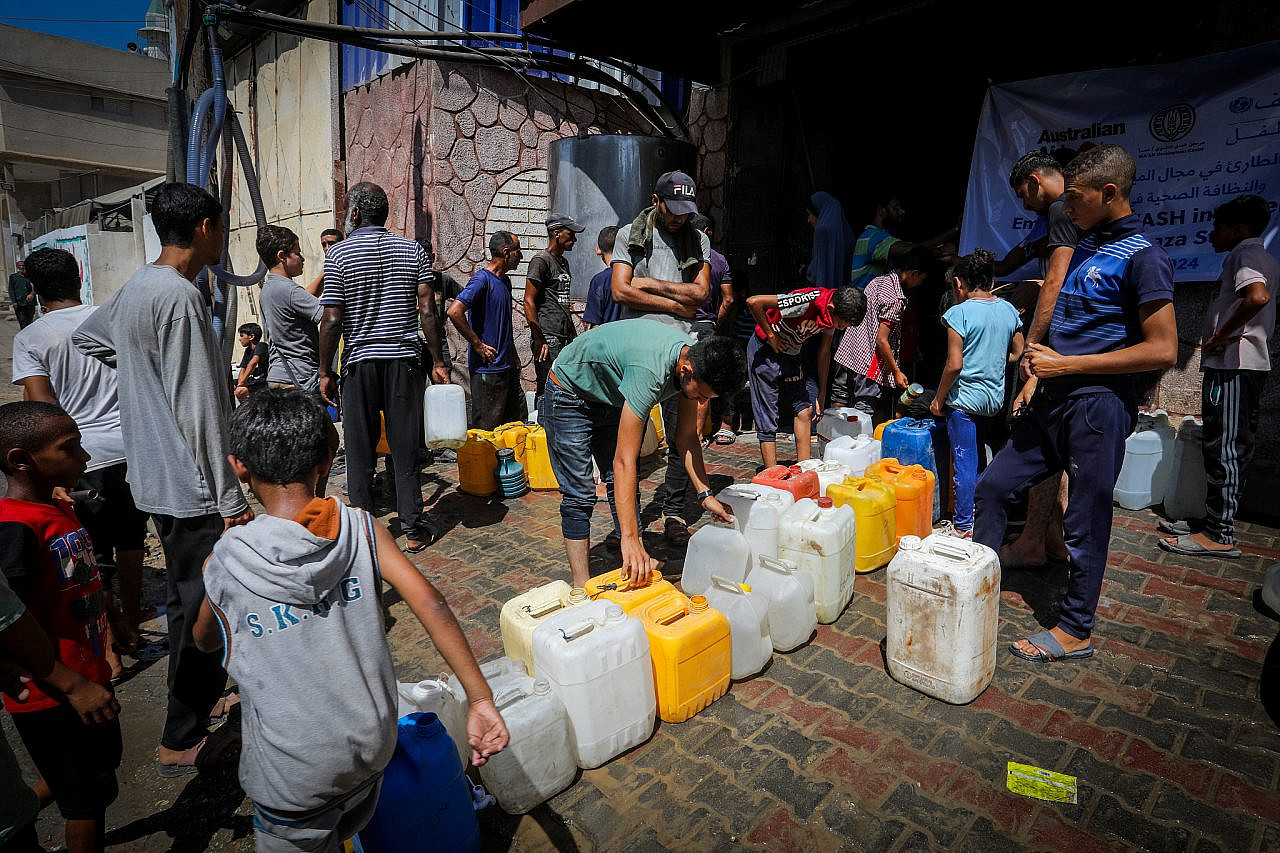
The Israeli government uses water as yet another tool to attack and punish the Palestinian population. The situation is completely unsustainable in the West Bank, but it is even worse in Gaza, where only 3% of the extremely scarce fresh water available to the Gazan population is drinkable. There is a stark contrast between Palestinian areas (especially those under direct Palestinian control), which in many cases receive less than half the daily minimum recommended by the WHO, and neighbouring Israeli settlements, which enjoy luxurious water consumption (swimming pools, water recreation areas, etc.).
In the West Bank, systematic practices of appropriation and restriction of water resources by the State of Israel have been documented. There is evidence of the destruction of wells by illegal settlers and the discriminatory channelling of water to Jewish settlements, while Palestinian communities suffer extreme rationing. Furthermore, in the West Bank, many communities depend on tanker trucks or untreated sources, which makes access more expensive and increases health risks. The state-owned corporation Mekorot manages water through a monopoly that has a network of infrastructure that prioritises Israeli consumption, violating basic human rights and consolidating a system of water apartheid.
This model follows the same development patterns as the so-called ‘water wars’ in Latin America, where transnational companies privatised natural sources in Bolivia, Chile and Mexico. There, as in Palestine, geopolitical interests, corporate control and facilitating legal frameworks converge, leaving indigenous populations without access to an essential resource. Both Mekorot and Latin American corporations operate through alliances between state powers and private entities, creating scenarios of water strangulation that intensify inequalities and worsen living conditions. In both contexts, community resistance is criminalised and any type of collective legal action is obstructed. In the Palestinian case, the commodification of water is also used, as in Latin American cases, as a tool for dominating the working classes, although in this case it is also used as an instrument of punishment and colonisation.
The situation in Gaza is even more extreme and represents an extreme case of induced water collapse. Virtually all of the water from the coastal aquifer is contaminated by salinisation and sewage discharges, meaning that more than 97% of fresh water is unfit for human consumption without treatment. The blockade, the destruction of infrastructure and restrictions on the entry of materials prevent the repair and development of desalination and sanitation plants on a sufficient scale. As a result, the population of Gaza is forced to rely on water purchased from private suppliers or humanitarian aid, making access to drinking water a matter of daily survival and yet another instrument of collective punishment and repression of the civilian population.
The situation in Palestine highlights the global scale of extractive and colonial capitalism, where water simultaneously becomes a weapon of occupation and an object of speculation. This resource is used as an instrument of war to attack and subjugate the Palestinian population, whose access to drinking water does not depend on environmental or technical criteria, but on political and colonial power relations.