
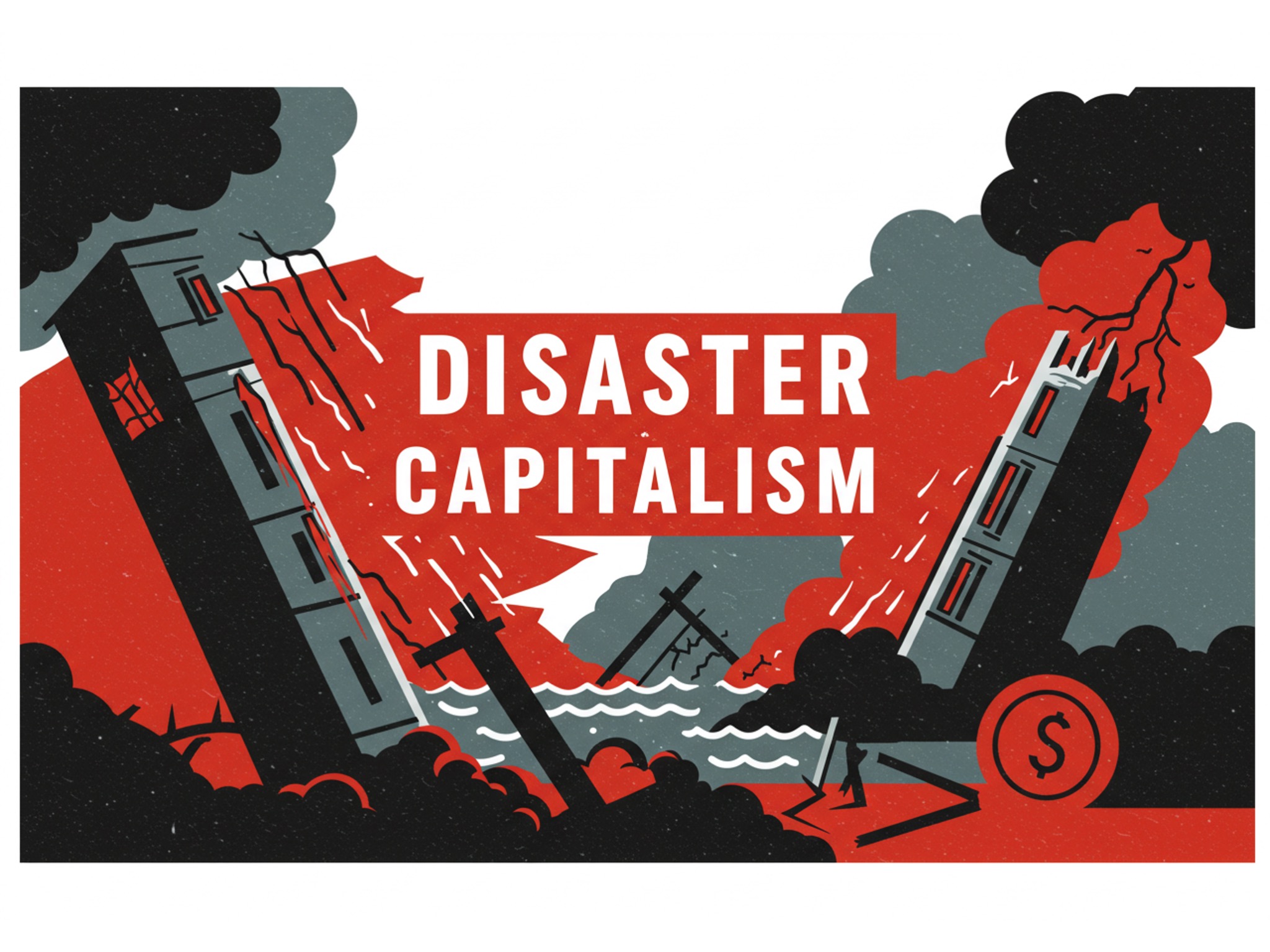
The so-called shock theory (or shock doctrine), formulated by the writer Naomi Klein, explains how economic and political powers exploit deep crises to push through unpopular reforms that, under normal conditions, would be rejected by the public. The central premise is that, while societies are stunned by the trauma of a disaster, social rights are dismantled and processes of privatization are enabled. This doctrine, far from being an academic abstraction, has appeared in various episodes since the late 20th century and can be clearly traced in the chain of crises of the 21st century.
The 2008 financial crisis was the first major setting for this strategy. The bank bailout with public money amounted to the socialization of private banking losses. The bursting of the housing bubble was used as justification for the government to approve a fast-track reform of Article 135 of the Constitution, agreed upon by the two main political parties. This amendment prioritized debt repayment over any other social need, consolidating austerity as a structural mandate. The consequences translated into cuts in healthcare, education, and long-term care, whose lasting impact shows how the crisis served as justification for a profound restructuring of public spending.
The COVID-19 pandemic did not halt this dynamic, but in some respects accelerated it by reinforcing the concentration of consumption in large corporations. While the population remained in lockdown and the hospitality sector fell into crisis, the supermarket chain “Mercadona” recorded its best financial year to date in 2020, with a 17% increase in profits. This trend continued in the following years (except in 2021). Between 2019 and 2025, “Mercadona” profits increased by 177.53%, a very significant rise that contrasts with the worsening economic conditions of a large part of the population.
The sequence of these events draws a recurring and recognizable pattern. Successive crises do not act as spaces for strengthening solidarity, but rather as opportunities for capital accumulation and the erosion of the common good. Destruction, whether financial, health-related, or climate-related, creates favorable conditions for certain economic actors to impose an order that, in times of stability, would face greater democratic resistance.
References
-
Naomi Klein (2007). “A doutrina do shock. O auxe do capitalismo do desastre”. Editorial Paidós.
-
Turiel Martínez,A. G. Informe sobre la legitimidad de la deuda pública de la Administración Central del Estado de España. https://cdn.vientosur.info/archivos_spip/pdf/Agustin-Turiel-informe-sobre-la-deuda-ilegitima.pdf
-
El Confidencial (2021). Mercadona supera sus récords el año del covid con 727M de beneficio y 26.932 en ventas. https://www.elconfidencial.com/empresas/2021-04-20/mercadona-resultados-2020-coronavirus_3041983/
-
El Salto. El margen de beneficios de Mercadona aumenta un 23% y gana un 40% más en 2023. https://www.elsaltodiario.com/alimentacion/margen-beneficios-mercadona-aumenta-un-735percent-gana-40percent-2023#
-
Europa Press. Mercadona gana 1.729 millones en un 2025 “histórico”, un 25% más, y logra ventas de 41.900 millones. https://www.europapress.es/economia/noticia-mercadona-gana-1729-millones-2025-historico-25-mas-logra-ventas-41900-millones-20260310122037.html