
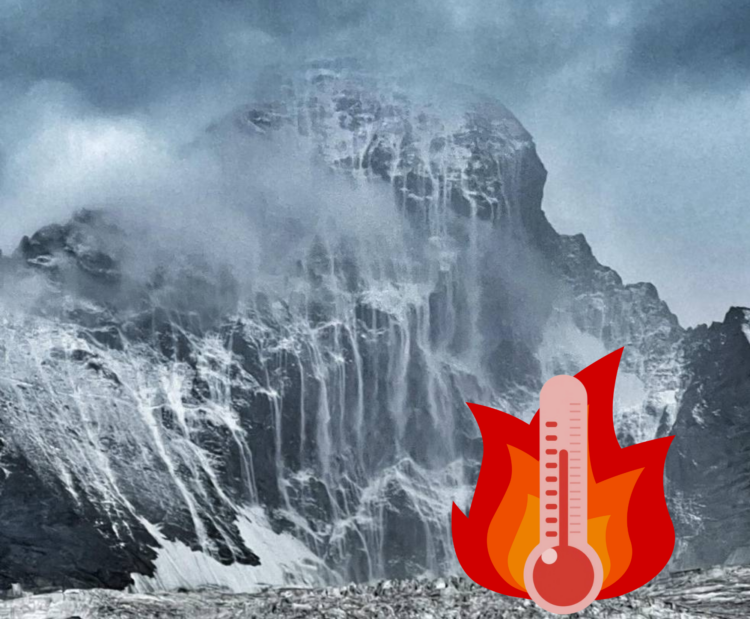
The Spanish Meteorological Agency (AEMET) is warning today of the arrival of a new heat wave, even as Europe has not yet recovered from the previous one. After a record-breaking hot May came an even worse June, with temperatures in southern Europe between 5 and 12°C higher than normal for the season, and it appears that temperatures will remain scorching this July as well.
On June 23, Météo-France reported that the day was the hottest since records began in 1947. In France, with temperatures exceeding 45°C, several nuclear reactors had to be shut down due to the extreme heat—a development that had not been anticipated. In addition to causing the deaths of thousands of people, heat waves greatly increase the risk of wildfires, especially given the drought conditions across much of southern Europe.
According to Rubén del Campo (AEMET), “In 2025, Spain experienced a heat wave on one out of every three days.” Global warming caused by fossil fuel emissions has worsened heat waves in Europe in just a few decades, and some areas of the continent are experiencing up to 40 more days of extreme heat stress than in the 1970s. Furthermore, the periodic tropical warming event known as El Niño has added fuel to the fire this year.
The planet’s global temperature rose by more than 0.4°C during the previous El Niño period, in 2023 and 2024, surprising climate scientists. Part of this extreme warming may be due to restrictions on aerosol emissions from commercial ships. Aerosols are airborne dust particles that are emitted alongside greenhouse gases and absorb some of the sunlight, reducing the greenhouse effect. There is significant uncertainty regarding their impact on global warming, as studying them is complex.
We have already exceeded the 1.5°C safety threshold for warming, the target set by the failed Paris Agreement that was not to be exceeded. The Earth is now hotter than at any time during the Holocene, the last 11,700 years. The planet is becoming uninhabitable in many regions. Adaptation and mitigation strategies are more urgent than ever: an end to fossil fuels, regenerative agriculture, welcoming climate refugees… and a profound systemic change.
The end of capitalism is inevitable. All that remains is to decide whether to dismantle it in an attempt to mitigate the worst effects of an unstoppable climate crisis or to wait for it to collapse along with human civilization.
Sources
- Agencia Estatal de Meteorología (AEMET). (2026, 4 de julio). Aviso especial. Ola de calor (Aviso especial de fenómenos adversos número 20/2026). https://www.aemet.es/es/eltiempo/prediccion/destacados/p5_t?tipo=p52tesp1
- Desnivel. (s. f.). Una cascada en la cara norte del Cervino vuelve a evidenciar el cambio climático en los Alpes. https://www.desnivel.com/alpinismo/una-cascada-en-la-cara-norte-del-cervino-vuelve-a-evidenciar-el-cambio-climatico-en-los-alpes/
- El Confidencial. (2026, 26 de junio). Francia se ve obligada a cerrar dos reactores nucleares por culpa del calor y ese es un problema con el que Europa no contaba. El Confidencial. https://www.elconfidencial.com/tecnologia/2026-06-26/francia-cierra-centrales-nucleares-calor-1qrt_4379255/
- IPCC. (2023). AR6 Synthesis Report: Climate Change 2023.
- laSexta. (2026, 4 de julio). Una ola de calor tras otra: la nueva normalidad del verano en España con temperaturas cada vez más extremas. laSexta.com. https://www.ipcc.ch/report/sixth-assessment-report-cycle/
- Hansen, J.E. et al. (2025). Global Warming Has Accelerated: Are the United Nations and the Public Well Informed? Environment: Science and Policy for Sustainable Development, Vol 67, 2025 – Issue 1 https://www.tandfonline.com/doi/full/10.1080/00139157.2025.2434494#abstract
- World Weather Attribution. (2026). Fossil fuel emissions have rapidly worsened European heatwaves in just a few decades. https://www.worldweatherattribution.org/fossil-fuel-emissions-have-rapidly-worsened-european-heatwaves-in-just-a-few-decades/