
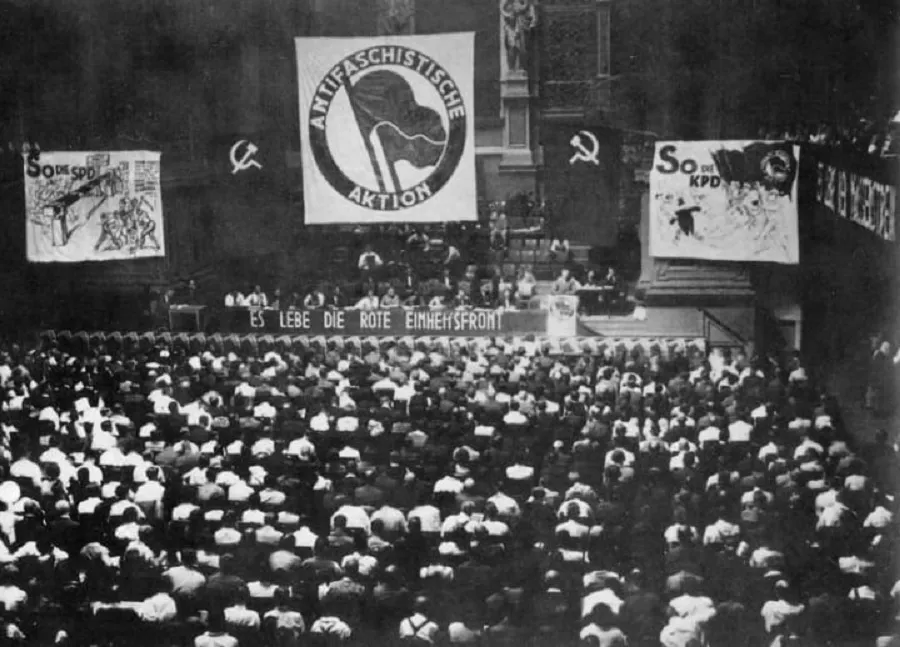
Anti-fascism emerged in Europe about a century ago as a response to the expansion of fascism. It gained relevance after Mussolini came to power in Italy (1922) and Adolf Hitler in Germany (1933).
Its main organizational manifestation in the early days were the Popular Fronts of the 1930s, which tried to stop the fascist danger in most Western European countries. Regarding the Spanish State, during the spanish Civil War, anti-fascism became a mass phenomenon of international scale with the participation of the International Brigades. In Germany, the White Rose group, led by the Scholl siblings, were executed in 1943, but their legacy endures as a symbol of youth opposition to Nazism.
It is a heterogeneous movement, which has grouped together communists, socialists, anarcho-syndicalists, left-wing republicans, and progressives in general, along with broad sectors of the intelligentsia.
Currently, various far-right and neo-Nazi organizations are carrying out an active campaign to criminalize the anti-fascist movement. Thus, Vox registered a non-legislative proposal in Congress that would demand the dissolution of organizations linked to “Antifa” and their inclusion in the European Union’s list of terrorist organizations. This movement follows the strategy tested by Trump, who signed an executive order designating “Antifa” as a “domestic terrorist organization.”
Faced with this offensive, anti-fascism remains a tool for analysis and resistance against authoritarian advances. The response of organized citizens ranges from general strikes and mass protests to surveillance and interference actions against repressive policies and fascist groups.