
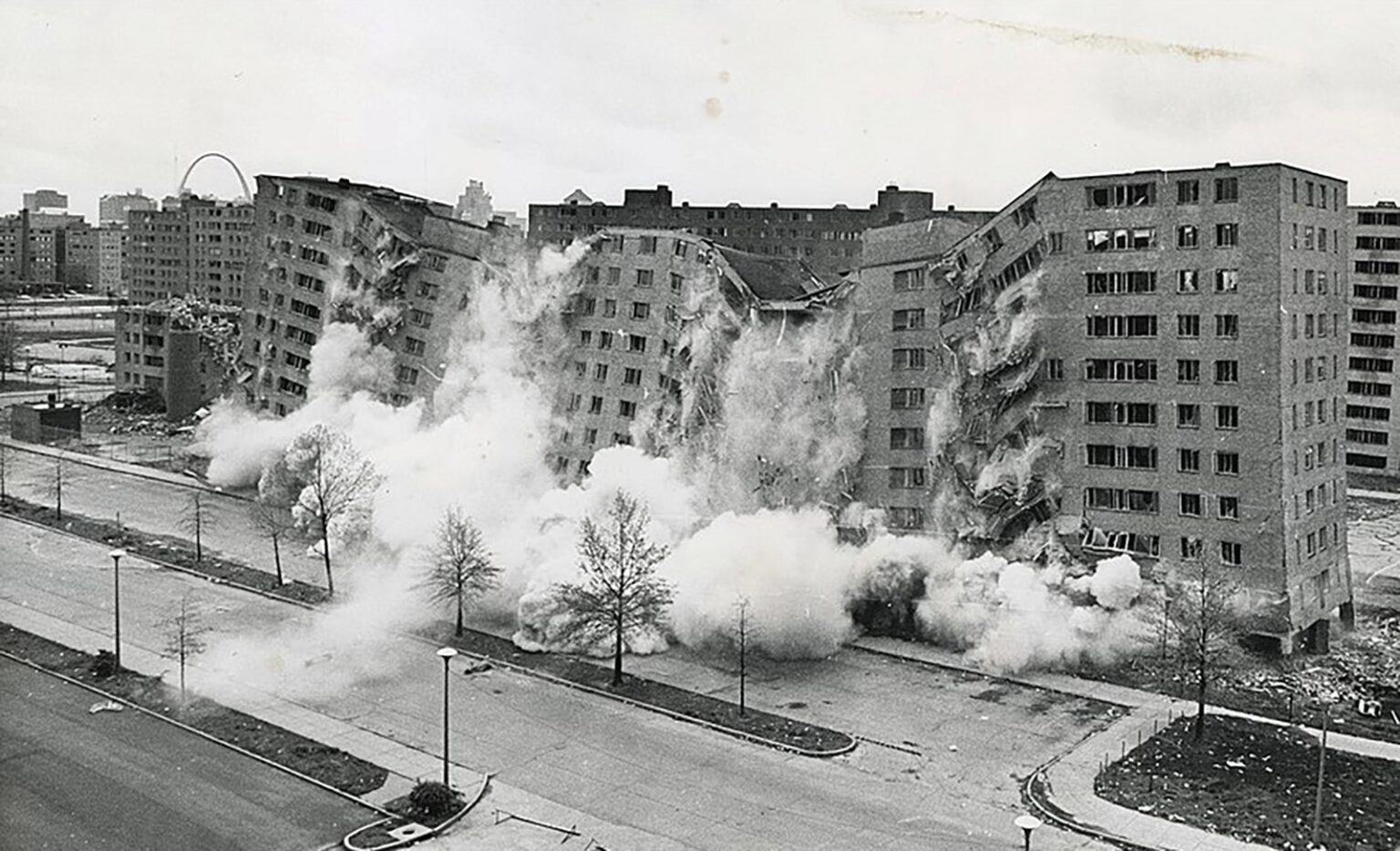
The documentary “The Pruitt-Igoe Myth” (2011), directed by Chad Freidrichs, tells the story of the Pruitt-Igoe public housing complex, built in 1954 and demolished in 1976 in Saint Louis, Missouri (United States). The film examines the socioeconomic causes and the institutional racism and classism that led to the failure of the project, which was used for decades by certain groups to justify racist ideas and portray public housing as a model doomed to fail in the United States.
The Pruitt-Igoe complex was conceived under the Federal Housing Act of 1949, a federal initiative that provided funding to cities for the clearance of deteriorated neighborhoods (“slums”), urban redevelopment, and the construction of affordable housing. The legislation, which proclaimed the goal of “a decent home and a suitable living environment for every American family,” was based on the premise that social problems could be solved simply by providing housing, without addressing the structural causes that sustained inequality.
In the article “The Pruitt-Igoe Myth,” published in 1991, Katharine G. Bristol, a professor at the University of California, Berkeley, argues that the failure of the complex was not the result of its architecture or its residents (the dominant explanations at the time), but rather stemmed from the socioeconomic structural conditions of the city of Saint Louis and specific political decisions.
On the one hand, demographic trends were not properly anticipated. During those decades, a significant portion of the white American middle class moved to suburban metropolitan areas, where housing was more affordable. This increased the availability of affordable housing within the city itself. Furthermore, the location of the project in the North Side of Saint Louis, an area with a high concentration of Black residents and lower-income households, reinforced segregation from the outset.
On the other hand, the limited budget allocated to the project meant that it was built using very low-quality materials, accelerating its deterioration from the moment it opened. The quality of the materials was so poor that deterioration was inevitable: doorknobs and locks broke after their first use, and window frames could not withstand wind pressure.
These factors, together with the strict regulations imposed on residents by the government, such as prohibiting fathers from remaining in the household, led to a gradual exodus of families with greater financial resources, leaving behind only the lowest-income households. Under the Housing Act of 1949, maintenance costs for housing projects had to be covered by local housing authorities through the rents paid by tenants. This situation created a severe maintenance deficit due to insufficient funding, accelerating the complex’s decline. The spiral of deterioration and violence intensified until local authorities declared the complex uninhabitable and ordered its final demolition in 1976.
The controlled demolition of the first three buildings in 1972 was televised and became an iconic image that, for decades, was used as a symbol of the supposed failure of modernist architecture and public housing. It also served to legitimize racist narratives that attributed alleged cultural pathologies to the residents.
The documentary “The Pruitt-Igoe Myth” adopts Bristol’s arguments and focuses on the real institutional and structural causes of the project’s failure while giving a voice to the people who lived there.
The Housing Act of 1949 was used as a mechanism to remove disadvantaged social classes from urban centers in order to promote economic development and increase land values. Economic and institutional racism, expressed through inadequate maintenance, poor construction resulting from budget cuts, and the absence of basic services, contributed to the creation of new ghettos of poverty and racial segregation, where Black and migrant populations were confined with limited opportunities for social mobility.
Both the documentary and Katharine G. Bristol’s article remain essential tools for understanding the limitations of housing policies when they are not accompanied by broader measures aimed at addressing economic and social inequalities. The case of Pruitt-Igoe demonstrates that the construction of affordable housing alone is insufficient to guarantee social integration or equal opportunity. Reducing segregation and exclusion requires complementing housing policies with strategies for wealth redistribution, access to employment, investment in public services, and community development capable of addressing the structural roots of inequality.
Documentary: https://vimeo.com/857879100
Sources
-
The Pruitt-Igoe Myth (2011). About. https://pruitt-igoe.com/about.html
-
Bristol, G.K. (1991). The Pruitt-Igoe Myth. https://urbanpolicy.net/wp-content/uploads/2015/06/Bristol1991_Pruitt-Igoe_Myth.pdf