
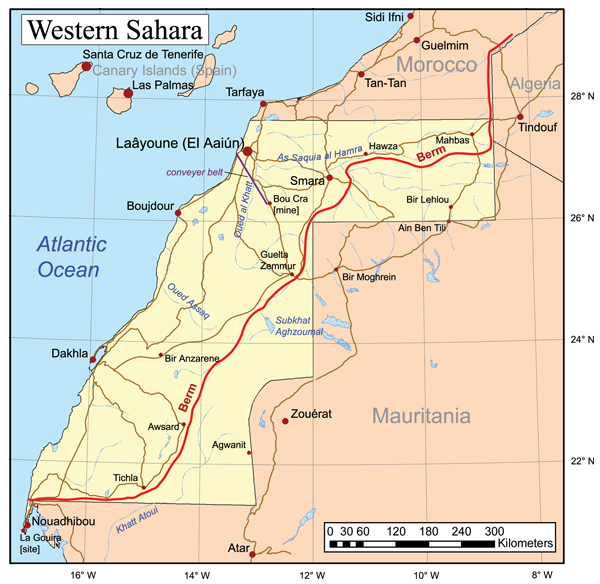
In 1963, the UN adopted Resolution 1956 (XVIII), which included Western Sahara on the list of Non-Self-Governing Territories pending decolonisation and reaffirmed the right of the indigenous population to self-determination. In 1965, the UN requested that the Spanish State begin the process of decolonisation and, in 1966, requested that the necessary measures be initiated to hold a self-determination referendum under the auspices of the United Nations. In 1973, the Polisario Front, a national liberation movement, emerged with the aim of achieving independence from the Spanish State.
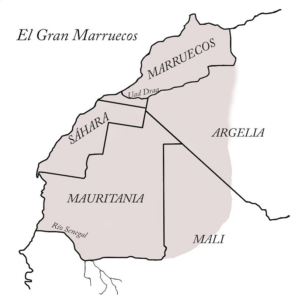
Morocco’s claims over the territory of Western Sahara date back to its origins as an independent state in the 1950s. The political elite behind the creation of the present-day state promoted the idea of Greater Morocco, a thesis that emerged in the 1920s, according to which the country should encompass «the present-day state, Western Sahara, the whole of Mauritania, the western regions of Algeria, northern Mali, and the Spanish cities of Ceuta and Melilla, as well as the Spanish territories under sovereignty in North Africa —Perejil Island, Vélez de la Gomera, Alhucemas and the Chafarinas Islands—». These ideas continue to exert considerable influence on the current monarchy.
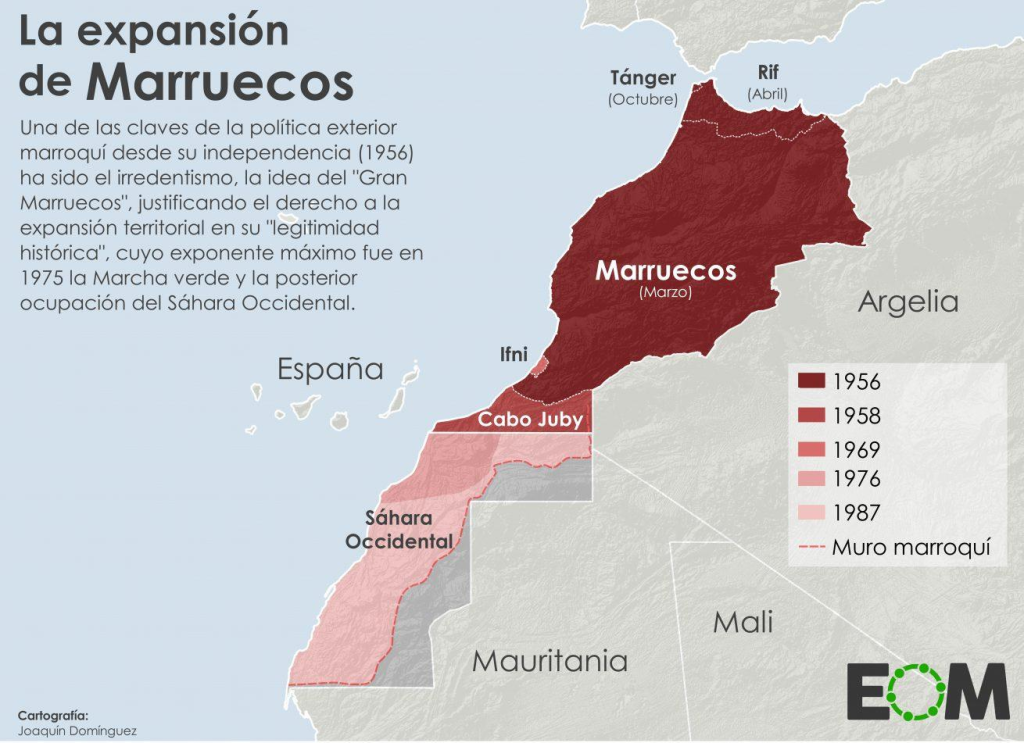
 On 16 October 1975, the International Court of Justice dismissed Morocco’s and Mauritania’s claims of sovereignty over the territory. However, before this ruling, Hassan II, Morocco’s monarch and a supporter of the Greater Morocco project, had already spent months planning the annexation of the territory with the assistance of the United States. This operation would materialise through what became known as the «Green March». On 6 November 1975, encouraged by the monarchy, 350,000 civilians and 25,000 military personnel from Morocco entered Western Sahara. On the same day, the UN Security Council condemned the «march» and called on Morocco to withdraw all participants from the territory.
On 14 November 1975, the Spanish Government signed what became known as the «Madrid Agreement» or the «Madrid Tripartite Accords», without consulting the Sahrawi people, under which it withdrew from Western Sahara and left it in the hands of Morocco and Mauritania, constituting a violation of international law and of the Sahrawi people’s right to self-determination.
Following this, the military invasion of Western Sahara began, and the Polisario Front launched an armed struggle to defend its people. On 26 February 1976, the Spanish Government definitively ended its presence in the territory without fulfilling its obligations regarding decolonisation as the administering power and abandoned the Sahrawi people. On the same day, the Sahrawi National Council proclaimed the Sahrawi Arab Democratic Republic (SADR), which formed its first government a few days later. During the following days, the SADR obtained official recognition from Madagascar, Burundi and Algeria. Since then, the list has grown to 84 countries. However, many of these countries subsequently severed relations, and a minority recognised Morocco’s sovereignty over the territory.
Algeria had gained its independence in 1962 after holding a self-determination referendum following eight years of war against France, the colonial power. It subsequently became a country with a socialist orientation that nationalised French companies. When the Western Sahara conflict broke out, it gave its support to the Polisario Front. In the midst of the Cold War, the United States and France would act as allies of Morocco and Mauritania.
The United States’ support for Morocco forms part of a long tradition of backing authoritarian regimes. Since the Second World War, Washington has intervened in numerous countries to safeguard its strategic and economic interests, aligning itself with dictatorial leaders who guaranteed policies favourable to its objectives and encouraging the removal of any government or dissident movement that posed a risk to its corporate interests. Guatemala in 1954, the dictatorships of the Southern Cone during the 1970s and 1980s within the framework of Operation Condor, and support for the Somoza dictatorship in Nicaragua are examples of this policy. However, these cases are only a sample of an interference that has also extended to other continents.
The Polisario Front defeated Mauritania in 1979, which would recognise the SADR in 1984. During the following years, the conflict between the Polisario Front and Morocco continued while the UN reaffirmed the right to self-determination and independence of Western Sahara and worked towards holding the referendum. In 1991, the UN established the United Nations Mission for the Referendum in Western Sahara (MINURSO) and a ceasefire was reached.
This provided some respite for the Sahrawi population, which had been suffering all kinds of atrocities since the outbreak of the conflict in 1975. From that moment onwards, an exodus of the population from the cities towards the interior of the territory had begun. Thus, a camp for displaced people was established in Oum Dreyga, in the central part of the country. This camp was bombed by Morocco with napalm and white phosphorus, whose use against the civilian population is currently specifically prohibited, between 19 and 21 February 1976, when the Spanish Government’s official withdrawal from the territory had not even yet taken place. This is one of the most notable and best-documented episodes, but it was not the only one. A legal complaint filed by the Association of Families of Sahrawi Prisoners and Disappeared Persons (Afapredesa) and the International Association of Jurists for Western Sahara alleges that, between November 1975 and the 1991 ceasefire, «there was a systematic attack against the Sahrawi civilian population by the Moroccan military and police forces: bombings of civilian population camps, forced displacement of civilians, killings, arrests and disappearances of people, all of Sahrawi origin, precisely because of that origin, with the aim of totally or partially destroying that population group and seizing the territory of Western Sahara».
In 2015, Spain’s National Court indicted eleven high-ranking Moroccan military and police officials for crimes of genocide in Western Sahara between 1975 and 1992. The charges included unlawful detention, torture, murder and enforced disappearance. At present, the accused remain unaccountable. They have not given testimony before the judge due to the inaction of the Spanish Government and Morocco’s obstruction of the judicial proceedings. Despite this, the Spanish State and the EU maintain diplomatic and commercial relations with a country that does not cooperate in the face of something as serious as an accusation of genocide.
Following the attacks, most survivors settled in Tindouf, in Algerian territory, where more than 170,000 people still live today.
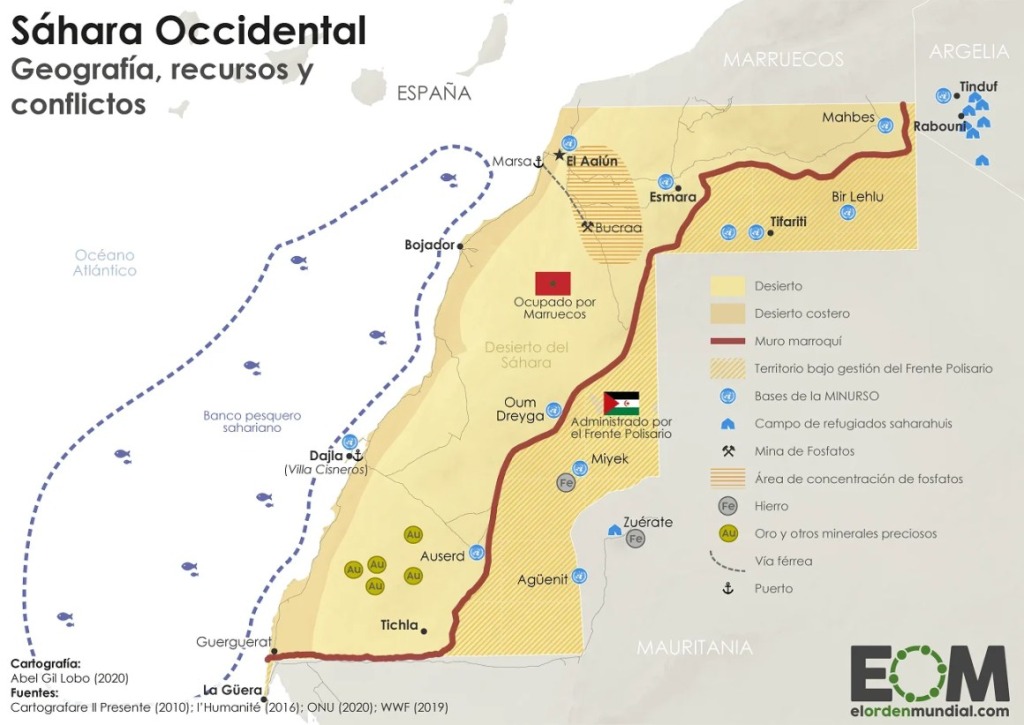
Although MINURSO’s mandate is renewed every October, 35 years later the referendum has still not been held. For this reason, various organisations consider that the UN has acted as a passive actor in the face of Morocco’s annexationist actions, regarding it as an accomplice by allowing the occupation to become entrenched. They also denounce the role of France, which, as Morocco’s unconditional ally, has blocked any progress by MINURSO towards holding the referendum, while also opposing the mission being granted powers to monitor human rights, as is the case with other international missions of this kind. Of course, economic interests lie behind all of this. On the one hand, French companies are the main actors responsible for the illegal exploitation of Western Sahara’s natural resources and, on the other, Morocco is an important customer for the purchase of French weaponry.
This perception of the UN’s ineffectiveness in resolving the conflict worsened in 2025, when the Security Council adopted a resolution «which considers that genuine autonomy for Western Sahara under Moroccan sovereignty could constitute a viable solution» to the conflict.
The «Moroccan autonomy plan for Western Sahara» was a proposal put forward by Morocco as a solution to the conflict in 2007. Despite having no legitimacy to claim sovereignty over the territory, it proposes as the only solution that the territory be recognised as part of Morocco, allowing a certain degree of «self-government» through its own institutions and eliminating any possibility of independence.
In 2020, the United States became the first country to officially recognise that sovereignty. This recognition came less than a month after Morocco violated the ceasefire signed in 1991 by attacking Sahrawi civilians who were peacefully demonstrating in El Guerguerat to denounce human rights violations and the plundering of their territory’s natural resources. As with everything in geopolitics, this recognition came at a price: the establishment of diplomatic relations between Morocco and Israel. Morocco thus became the fourth country to take part in the Abraham Accords. Promoted by the United States, the aim of these agreements is to normalise diplomatic relations between the Zionist state and several Arab countries.
In 2023, Israel became the second country to recognise Moroccan sovereignty, followed by Paraguay, in 2025, and Colombia, in 2026, among others, although this remains a clearly minority position. In the case of these latter two recognitions, they came within the context of conservative and far-right governments which, influenced by the Zionist lobby, prioritised the pursuit of trade agreements and the promotion of the geostrategic interests of the United States and Israel over considerations of international law in this conflict.
In 2022, the Spanish Government shifted in favour of Morocco and abandoned its position in defence of the Sahrawi people’s right to self-determination when President Pedro Sánchez acknowledged that the «Moroccan autonomy plan» was the best solution to the conflict. This represented a further step in the Spanish Government’s historical betrayal of this people and in the abandonment of its responsibilities regarding the territory.
In 2024, France, Morocco’s historic ally, officially positioned itself in favour of Morocco, recognising that the future of the territory depends on recognising Moroccan sovereignty. There are other states that have expressed support for the autonomy plan without officially recognising Moroccan sovereignty, but, once again, this remains a minority position.
Morocco’s diplomatic pressure and the hypocrisy of the EU go so far that the latter is willing to bypass international law through trade agreements with Morocco that violate the rights of Western Sahara, despite rulings by the Court of Justice of the European Union (CJEU).
Despite the atrocities committed by Morocco in Western Sahara, international inaction continues. Diplomatic and commercial relations continue to be maintained with a country that has systematically and flagrantly violated human rights, committed serious and ongoing violations of international humanitarian law, and failed to hand over to justice those convicted of genocide by international courts, without any real and effective efforts being made to ensure respect for international law. Not only do other actors turn a blind eye, but powers such as France have directly contributed to the consolidation of the occupation by providing military and economic aid and by blocking any progress at the UN towards holding the referendum, while their companies profit from the plundering of the territory’s natural resources with Morocco’s unlawful consent. Meanwhile, various organisations continue to denounce the hundreds of unresolved cases of enforced disappearances, torture, ongoing colonisation and arbitrary detentions…
Sources:
-
AFAPREDESA (s.f.). AFAPREDESA-Annex-1. https://www.ohchr.org/sites/default/files/Documents/Issues/Truth/CallLegacyColonialism/CSO/AFAPREDESA-Annex-1.pdf
-
Naciones Unidas (2026). Territorios No Autónomos. https://www.un.org/dppa/decolonization/es/nsgt
-
Sáhara Occidental (2023). Historia del Sáhara Occidental. https://saharaoccidental.es/historia-del-sahara-occidental/breve-historia-sahara-occidental/
-
Sáhara Occidental (2026). El Frente Polisario. https://saharaoccidental.es/sahara/el-frente-polisario/
-
El Orden Mundial (2020). Sáhara Occidental, la última colonia en África. https://elordenmundial.com/sahara-occidental-ultima-colonia-africa/
-
El Orden Mundial (2023). Mapa del Gran Marruecos. https://elordenmundial.com/mapas-y-graficos/mapa-gran-marruecos/
-
RTVE (2010). 35 años de la Marcha Verde. https://www.rtve.es/rtve/20101006/35-anos-marcha-verde/359560.shtml
-
Sáhara Occidental (2026). Reconocimientos de la RASD. https://saharaoccidental.es/sahara/reconocimientos-de-la-rasd/
-
Wikipedia (2026). Conflicto del Sáhara Occidental. https://es.wikipedia.org/wiki/Conflicto_del_Sahara_Occidental
-
Wikipedia (2026). Opération Lamantin. https://en.wikipedia.org/wiki/Op%C3%A9ration_Lamantin
-
Wikipedia (2026). Argelia. https://es.wikipedia.org/wiki/Argelia
-
Público (2026). 50 años de impunidad: Marruecos bombardeó con fósforo blanco y napalm al pueblo saharaui. https://www.publico.es/internacional/africa/50-anos-impunidad-marruecos-bombardeo-fosforo-blanco-napalm-pueblo-saharaui.html
-
RTVE (2015). El juez Ruz procesa a once altos cargos, militares y policías marroquíes por genocidio en el Sáhara. https://www.rtve.es/noticias/20150409/juez-ruz-procesa-a-once-altos-cargos-militares-marroquies-por-genocidio-sahara/1126482.shtml
-
Survie (2025). Marche pour la liberté : le Maroc doit libérer les prisonniers politiques. https://survie.org/l-association/mob/article/marche-pour-la-liberte-le-maroc-doit-liberer-les-prisonniers-politiques
-
L’Expression (2020). Sahara occidental : le rapport de Guterres est réducteur. https://www.lexpressiondz.com/info-en-continu/sahara-occidental-le-rapport-de-guterres-est-reducteur-323742
-
No te olvides del Sáhara Occidental (s.f.). Francia rechaza que la MINURSO supervise los derechos humanos en el Sáhara Occidental. https://noteolvidesdelsaharaoccidental.org/francia-rechaza-que-la-minurso-supervise-los-derechos-humanos-en-el-sahara-occidental/
-
AL24 News (2025). Polisario: Morocco continues to obstruct Western Sahara referendum with French backing. https://al24news.dz/en/polisario-morocco-continues-to-obstruct-western-sahara-referendum-with-french-backingpolisario/
-
Amnistía Internacional (2025). Sáhara: agonía y traición. https://blogs.es.amnesty.org/andalucia/2025/11/14/sahara-agonia-y-traicion/?mo=07&yr=2026
-
No te olvides del Sáhara Occidental (s.f.). Plan de autonomía marroquí para el Sáhara Occidental. https://noteolvidesdelsaharaoccidental.org/plan-de-autonomia-marroqui-sahara-occidental/
-
BBC News Mundo (2020). Acuerdos de Abraham: el histórico acuerdo entre Israel y Marruecos con el que Trump logra otra victoria diplomática. https://www.bbc.com/mundo/noticias-internacional-55267560
-
Sáhara Occidental (2025). Ruptura del alto el fuego en el Sáhara Occidental. https://saharaoccidental.es/historia-del-sahara-occidental/ruptura-alto-fuego-sahara-occidental/
-
El Sáhara Occidental (2023). Marruecos y los Acuerdos de Abraham. https://www.elsaharaoccidental.com/marruecos-y-los-acuerdos-de-abraham/
-
No te olvides del Sáhara Occidental (s.f.). Apoyo internacional a Marruecos sobre el Sáhara Occidental: un bulo. https://noteolvidesdelsaharaoccidental.org/apoyo-internacional-marruecos-sahara-occidental-bulo/
-
Lisa News (2024). Qué países apoyan el plan de autonomía de Marruecos sobre el Sáhara Occidental. https://www.lisanews.org/actualidad/que-paises-apoyan-el-plan-de-autonomia-de-marruecos-sobre-el-sahara-occidental/
-
elDiario.es (2024). La Justicia europea confirma la anulación del acuerdo pesquero entre la UE y Marruecos por vulnerar los derechos del pueblo saharaui. https://www.eldiario.es/desalambre/justicia-europea-confirma-anulacion-acuerdo-pesquero-ue-marruecos-vulnerar-derechos-pueblo-saharaui_1_11705936.html
-
elDiario.es (2025). La UE negocia con Marruecos un acuerdo comercial para productos del Sáhara Occidental pese a las sentencias judiciales. https://www.eldiario.es/internacional/ue-negocia-marruecos-acuerdo-comercial-productos-sahara-occidental-pese-sentencias-judiciales_1_12642710.html