
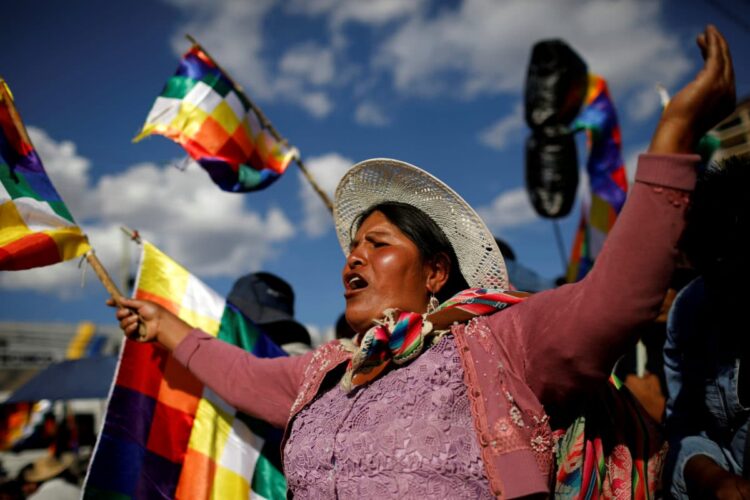
More than a month after the social outbreak in Bolivia, the government of Rodrigo Paz has still failed to respond to the people’s demands and is stepping up its repression: the recently enacted Law 1740, which regulates the state of emergency, gives the armed forces and police carte blanche to kill and torture with impunity. Repression and media manipulation have failed to stop the mass protests, blockades and roadblocks in a peasant, worker and indigenous uprising involving a wide range of groups. Among them are the Bolivian Workers’ Confederation (COB), the La Paz-based Tupac Katari trade union and Los Ponchos Rojos, as well as sectors including doctors, teachers, students, miners, transport workers and the Departmental Federations of Neighbourhood Councils.
The roots of this uprising lie in the shifting balance of power and the political crisis that has engulfed the country since the 2019 coup d’état: the far right refused to accept the election results that returned Evo Morales to the presidency, and launched an escalation of violence against the MAS (Movement Towards Socialism) with the support of the armed forces and police, which culminated in Evo Morales’ resignation and his disqualification from standing in the 2020 and 2025 elections. This also led to a split between the various factions of the MAS and a rift between Morales and Luis Arce, the new leader of the MAS, leaving the party severely weakened by the time of the 2025 elections, which were won by Rodrigo Paz.
Against this backdrop, Rodrigo Paz entered government with the slogan “Capitalism for all” and, by December 2025, began implementing extractivist and racist policies that go hand in hand with capitalism: Decree 5503 involved taking control of natural resources in circumvention of the constitution, leading to a massive rise in fuel prices. This government, moreover, wasted no time in re-establishing relations with the US and the genocidal state of Israel. This leads to the return of the DEA (US Drug Enforcement Administration), despite numerous allegations of corruption, and to increased surveillance: phones tapped by Israeli intelligence and the use of drones at demonstrations.
But everything comes to a head with the new unconstitutional Law 1720, which infringes upon indigenous peoples’ land rights. The Bolivian Amazon is mobilising without receiving a response from the state, and a 29-day march towards the seat of government is being organised. Rodrigo Paz’s response is to show contempt for the protesters, accusing them of being paid by Evo Morales and refusing to meet with them. Instead, he meets with the agribusiness and mining sectors, announcing a new package of laws that pose an even greater threat to indigenous peoples and their territories, as well as to education and healthcare. An agreement is also reached on the exploitation of lithium by US companies and an increase in electricity tariffs.
Following days of intense protests, strikes and roadblocks across the country, on 13 May Paz repealed Law 1720; however, food shortages, corruption and the government’s brutal crackdown on the protests, which left more than 400 people arrested and over 300 injured, led the people to demand the government’s resignation. The people’s demands also include opposition to the International Monetary Fund’s (IMF) austerity measures, opposition to the land law, an end to fuel subsidies and opposition to the return of the DEA.
The popular uprising springs from anger, dignity and hunger, without fear. The coordination of various social movements (feminist groups, dissident groups, workers’ movements…) sees these struggles as interconnected, with the same roots. Effective decolonisation and self-government by the people are urgently needed, as neoliberal democracies no longer serve their purpose. In Bolivia, the call for the unification of Abya Yala in the face of imperialism is being heard.
Sources:
-
Bolivia. Frente a la situación política nacional actual y la promulgación de la Ley de Estado de Excepción. Kaos en la Red (12 de junio de 2026). https://kaosenlared.net/bolivia-frente-a-la-situacion-politica-nacional-actual-y-la-promulgacion-de-la-ley-de-estado-de-excepcion/
-
Bolivia: rebelión en las venas. El Salto (7 de junio de 2025). https://www.elsaltodiario.com/bolivia/bolivia-rebelion-venas
-
Bolivia se Levanta. Cadenazo De Medios Libres. Radio Almaina (4 de junio de 2026). https://radioalmaina.org/tag/bolivia-se-levanta/
-
Entrevista con Gaby, Red de la Diversidad. Wayna Tambo (27 de mayo de 2026). https://radiowaynatambobolivia.blogspot.com/
-
Tupac Katari y la propiedad de la tierra, claves en las protestas de Bolivia. El Salto (25 de mayo de 2026). https://www.elsaltodiario.com/bolivia/tupac-katari-propiedad-tierra-claves-protestas-bolivia
-
Las protestas por la subida del combustible acorralan al presidente Rodrigo Paz en Bolivia. El Salto (1 de enero de 2026). https://www.elsaltodiario.com/bolivia/protestas-subida-del-combustible-acorralan-al-presidente-lara-bolivia