Global food security faces an unprecedented confluence of factors. The “Global Report on Food Crises” (GRFC) 2025 estimates that nearly 295.3 million people in 53 countries experienced high levels of acute food insecurity in 2024, the highest figure in nine years of monitoring. The analysis makes it clear that climate change, water scarcity, the fertiliser crisis and armed conflicts are creating a perfect storm that puts global food production at risk.
Global warming is already reducing crop yields. The European Parliament warns that rising temperatures and extreme weather events are damaging key crops such as wheat and maize, and pose a challenge to livestock and fisheries. Southern Europe is particularly vulnerable. At the same time, water scarcity is worsening the situation. The FAO points out that agriculture accounts for more than 70 % of global freshwater withdrawals, and its 2025 report on land and water resources highlights the urgent challenges of land degradation and water scarcity caused by human activity.
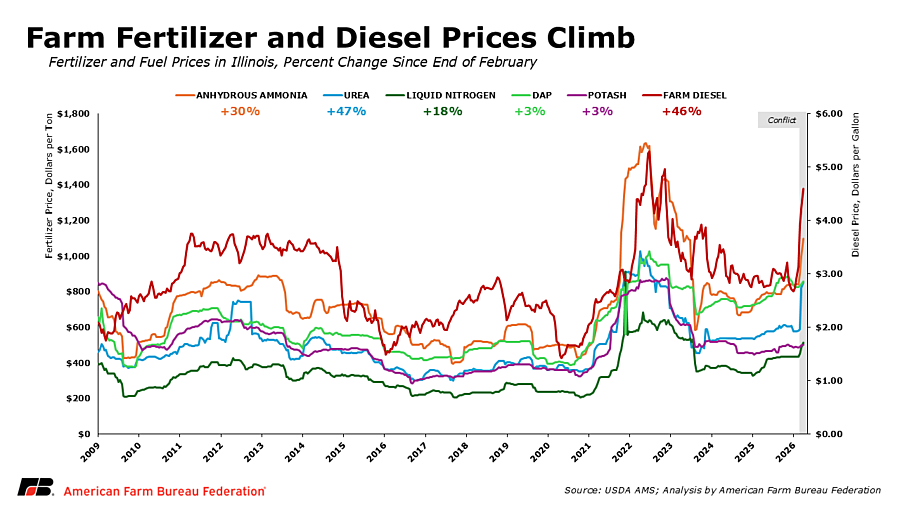
The fertiliser crisis is another critical factor. Nitrogen-based fertilisers are produced from natural gas, so higher energy prices directly drive up production costs. The FAO has warned that disruptions in the Strait of Hormuz, through which up to 30 % of global fertiliser trade transits, are already pushing prices higher. Fertiliser prices could be 15 or 20 % higher in the first half of 2026 if the crisis persists. In the Spanish State, farmers pay three times more for fertiliser while cereals sell at prices from a decade ago.
Geopolitical conflicts complete the picture. The GRFC 2025 confirms that conflict, economic crises, extreme weather events and forced displacement remain the main drivers of hunger. Gaza and Sudan are experiencing confirmed famines. However, each of these factors has known solutions: agroecological transition, sustainable water management, reducing fossil‑fuel dependence for fertilisers and preventive diplomacy. Their implementation, nevertheless, requires political will and democratic pressure that, so far, have not materialised with the urgency the crisis demands.
Sources:
-
European Commission (2025). Global Report on Food Crises 2025. Knowledge for Policy. https://knowledge4policy.ec.europa.eu/global-food-nutrition-security/global-report-food-crises_en
-
FAO (2025). Global Report on Food Crisis 2025 September Update – Full Report. https://www.fao.org/family-farming/detail/zh/c/1749065/
-
FAO (2025). The State of the World’s Land and Water Resources for Food and Agriculture 2025. https://www.fao.org/publications/fao-flagship-publications/the-state-of-the-worlds-land-and-water-resources-for-food-and-agriculture/es
-
FAO (2026). FAO Chief Economist warns of severe global food security risks from disruption to Strait of Hormuz trade corridor. https://www.fao.org/newsroom/detail/fao-chief-economist-warns-of-severe-global-food-security-risks-from-disruption-to-strait-of-hormuz-trade-corridor/en
-
IICA (2026). Conflict Could Drive Up Fertilizer Prices. https://test-assets-opsaa.iica.int/storage/resources/resource_1773699463_es.pdf
-
ASAJA (2025). ASAJA denuncia que los agricultores pagan tres veces más por abonar mientras el cereal se vende al precio de hace una década. https://www.asaja.com/asaja-denuncia-que-los-agricultores-pagan-tres-veces-mas-por-abonar-mientras-el-cereal-se-vende-al-precio-de-hace-una-decada/