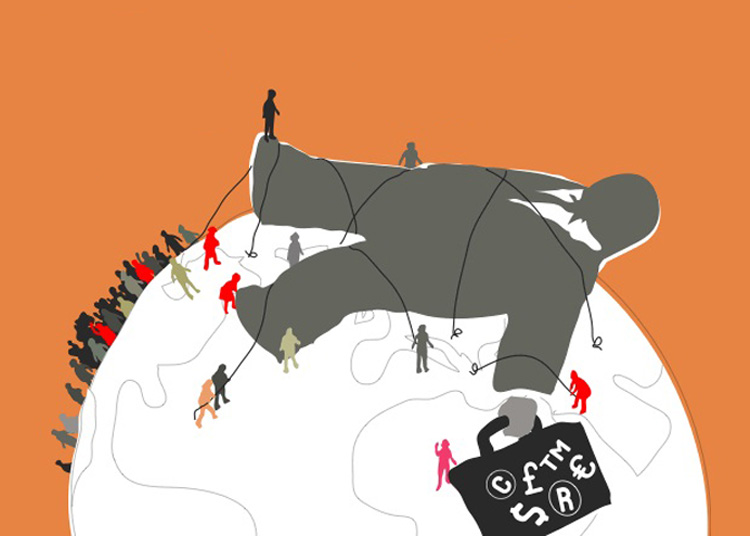
Transnational corporations (TNCs) constitute the great empires of the 21st century in globalized capitalism. Their concentration of economic, political, media and legal power poses a real threat to democracies, which have been weakened for decades.
They concentrate economic power, with a GDP greater than that of many States in some cases. This power grows year after year. In 2026, the revenues of the 500 largest TNCs account for 67% of global GDP. They concentrate political power, as through direct or indirect (and illegal) funding they promote those who will legislate in their favour and, through lobbying, manage to ensure that laws are made to suit them. They concentrate media power, as they own the vast majority of the media. Censorship is not necessary; it is enough to own the media, which, when well funded, ensure that their ideas receive wide dissemination, while critical media, due to a lack of funding, have limited reach and, in many cases, limited longevity. In this way, they manage to control common sense and decide which ideas are widely accepted.
This situation is extremely serious, since the objective of these multinationals is to increase their economic profits without any consideration for respect for human rights and the environment. Their concentration of power is such that they can systematically violate human rights and harm the environment with impunity. And this is where the fourth pillar comes in: their legal power. There is an entire architecture of impunity, also known as lex mercatoria, which not only allows these companies to violate human rights and harm the environment without consequences, but also protects their profits.
In response to this reality, the Stop Corporate Impunity campaign emerged: an international coalition made up of hundreds of organizations demanding a binding legal framework for transnational corporations.
The campaign emerged in 2012, during the Rio+20 Peoples’ Summit, when more than 150 organizations from Latin America, Africa, Asia, Europe and North America signed a call for joint action. Its origins can be traced back to the work of the Permanent Peoples’ Tribunal between 2006 and 2010, which tried 70 transnational corporations in 54 cases and concluded that violations are systematic and that voluntary corporate social responsibility codes do not resolve impunity.
The campaign denounces the fundamental asymmetry of the international system: while trade and investment treaties legally protect the rights of transnational corporations, the human rights standards that apply to them are voluntary and lack enforcement mechanisms. This legal architecture guarantees impunity for companies operating globally.
For this reason, since its launch, the coalition has promoted negotiations for a Binding Treaty at the UN to regulate transnational corporations and other business enterprises and put an end to corporate impunity, thereby preventing human rights violations and environmental destruction. In June 2014, the Human Rights Council adopted Resolution 26/9, which established the Open-ended Intergovernmental Working Group (OEIGWG) tasked with developing the legal instrument.
After more than 10 years, the twelfth session will take place from 12 to 16 October 2026, during which the final substantive elements of the Binding Treaty will be negotiated, ahead of what could be the final draft in 2027.
Over these years, there has been enormous pressure from the corporate lobby to ensure that the final form of the Treaty does not pose a real threat to their interests, securing modifications that represent genuine advances in their favour. For this reason, it is essential to gain ground during this final period of negotiations. And to do so, the Treaty must be placed at the forefront of the global discourse. Citizens need to know about the existence of this process and its significance. If the final form remains faithful to its original objectives, this Treaty could represent one of the greatest social advances of this century.
Sources:
-
Ecoar Global. Anticorporativismo e subversión. https://campanhas.ecoarglobal.org/gl/category/campanas/anticorporativismo-e-subversion/
-
Brady, D. (2026). The Fortune Global 500 gets top-heavy—and more powerful than ever. Fortune. https://fortune.com/2026/07/28/fortune-global-500-more-powerful-than-ever-amazon-jeff-bezos/#1
-
Stop Corporate Impunity (2022). 10º Aniversario de la Campaña Global. https://www.stopcorporateimpunity.org/wp-content/uploads/2022/10/10o-Aniversario-de-la-Campana-Global-2.pdf
-
Treaty Movement. https://www.treatymovement.com/about-us
-
OHCHR (2026). Twelfth session of the open-ended intergovernmental working group. https://www.ohchr.org/en/hr-bodies/hrc/wg-trans-corp/session12
-
Stop Corporate Impunity (2019). Normas vinculantes para enfrentar la impunidad de las empresas transnacionales. https://www.stopcorporateimpunity.org/wp-content/uploads/2019/05/TratadoVinculante_Presentacion_ESP.pdf