

Karl Popper, an Austro-British philosopher from the middle of the last century, said that a truly tolerant society should have the right to reject intolerant views. This is what is known as the paradox of tolerance: tolerating intolerance only leads to more intolerance.
Today we see how far-right views (racist, misogynistic, homophobic…) dominate the mainstream media. Television channels make more money from figures who spout nonsense and spread hate-filled messages because this attracts viewers. Mainstream social media amplifies these messages, not only because it is in the hands of conservative oligarchs, but also because even the left gives them visibility: these messages generate controversy, debate, and reactions of rejection, and all of this generates interactions, which is what the algorithms promote. Proyecto UNA explains this in their book “The Virality of Evil.”
All this contributes to the normalisation of these hateful stances. The concept of the Overton window represents the ideas acceptable to society as a narrow window that can shift to one side or the other as follows: a particular idea, for example the ban on abortion, starts out as unthinkable in a democratic society. With the rise of the far right in the media, this intolerant stance initially provokes outrage on the left and sparks debate, thereby becoming radical. As the debate intensifies in the media and on social media, this stance becomes normal and increasingly accepted, until it may even come to seem sensible, become popular and even political, eventually turning into law.
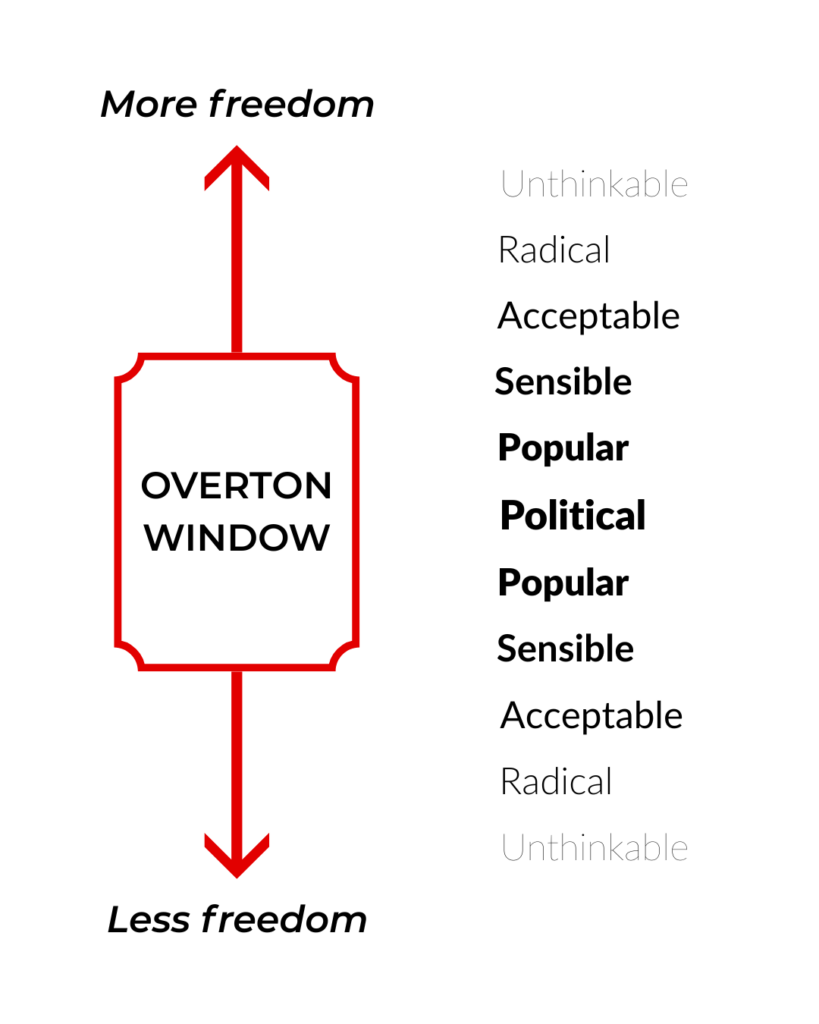
But there are ways to combat the normalisation of the far right and its ideology. One example is the ‘cordon sanitaire’, a measure whereby a decision is taken not to give these ideas a platform. In Belgium, particularly in the French-speaking region, journalists do not invite far-right figures onto programmes or report on these parties. This is a way of preventing the normalisation of discourse that runs counter to democratic values.
On social media, it is recommended not engaging with reactionary ideas, so as not to give them visibility or fall into the traps they seek to impose. On the streets, grassroots organisation and the anti-fascist movement are key to keeping the far right at bay. Fascism is not to be debated, it is to be fought.