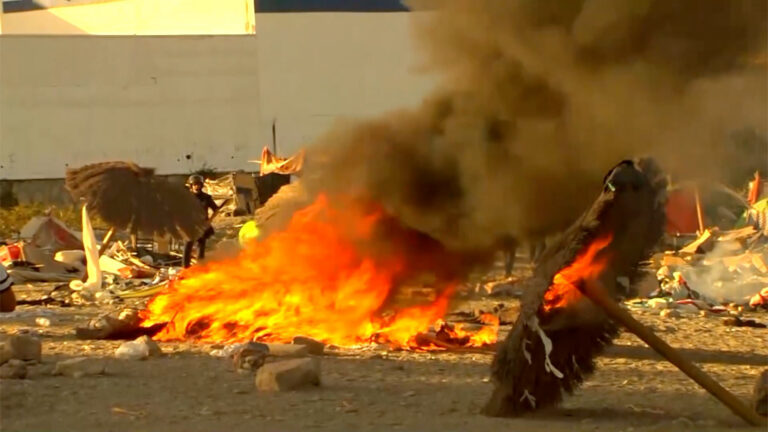
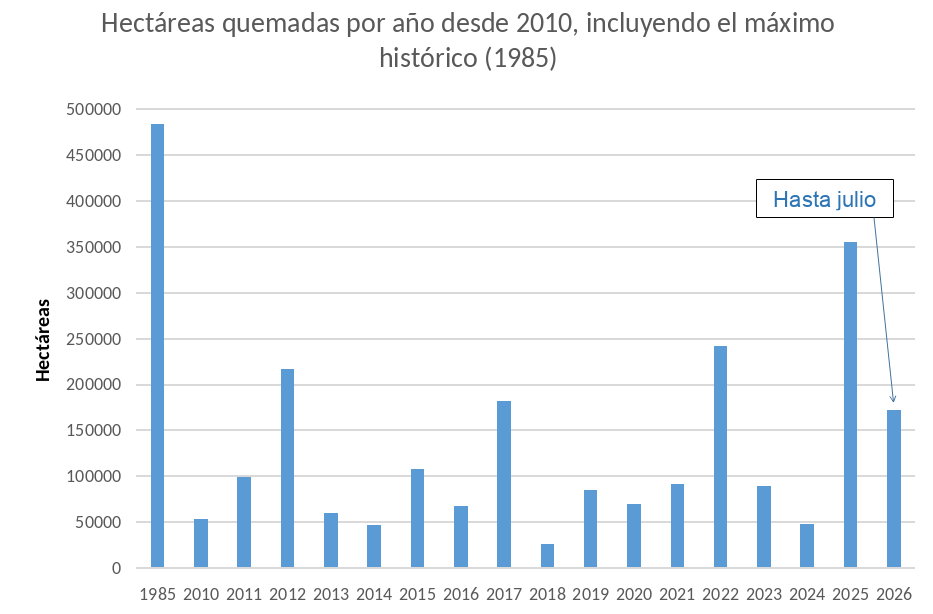
Once again this summer, wildfires dominate the headlines. The same images repeat: smoke, flames, affected communities, figures for hectares burned… In Spain, 172,453 hectares have already burned this year. But do we really understand these figures? Are they increasing compared to previous years?
The area burned so far this year is roughly equivalent to 31 times the area enclosed by Madrid’s M30 ring road. The record for hectares burned in Spain was set in 1985, with 483,844 ha — the equivalent of 87 times the area enclosed by the M30, a figure 4.6 times higher than the last decade’s average of 105,614 ha. With almost half the year still ahead and fires still active, the equivalent of 36% of that historic maximum has already burned.
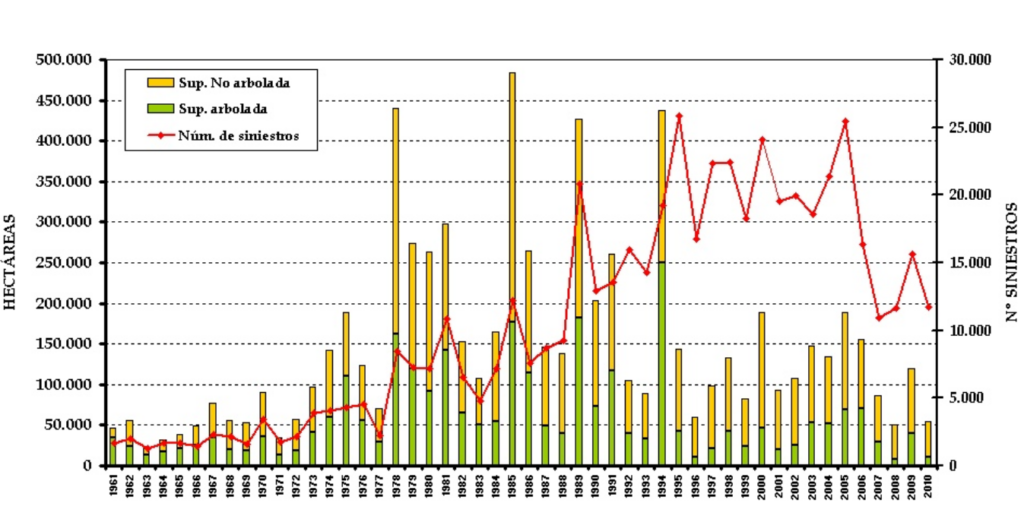
The charts below show the trend in the number of hectares burned from 1961 to 2025.
One factor that is making the situation especially severe this year is the so-called “whiplash effect”, a consequence of the heavy rainfall recorded last winter. This phenomenon occurs when abnormally heavy rain boosts the growth of all kinds of vegetation, which then dries out once heatwaves arrive. The result is a large build-up of plant fuel that, combined with the wind of recent days, is making firefighting efforts considerably harder.
These extreme weather events are not a matter of chance: their main cause lies in anthropogenic climate change — that is, in “the disruption experienced by the world’s various climates due to the overheating caused by the build-up in the atmosphere of certain gases emitted from the burning of fossil fuels (coal, oil and gas)”, a situation thoroughly confirmed by science.
These destructive effects of human activity on the planet stem mainly from a capitalist system based on the continuous exploitation of resources and the pursuit of economic profit above any other consideration. We thus find ourselves immersed in a model in which states protect the private profits of transnational corporations to the detriment of social measures that benefit the majority. Functions such as land management and public prevention policies are neglected, while public resources allocated to firefighting are cut. Moreover, the capitalist system concentrates economic activity in cities and in large agro-industrial and intensive livestock operations, which has for decades driven the depopulation of rural areas and, consequently, the lack of management of woodlands (no grazing, no scrub-clearing, no farming, no extensive livestock use).
To all of the above must be added the fact that human beings are behind the origin of most wildfires.
These shortcomings are the result of political decisions about where to invest public spending. Instead of using the machinery of the state to hand public resources over to private hands, to absorb private debt, to facilitate speculation on essential goods such as housing, or to increase military spending (which mainly benefits a small number of arms-industry companies), it is urgent to implement policies that take the first steps toward a change of model: one that puts the protection of people and the environment first. Achieving this transformation depends on social organisation, public pressure and the democratic demand for different priorities. It is urgent to strengthen the public sector and defend common goods.
Sources
- RTVE, “Mapa de incendios en España: última hora”. https://www.rtve.es/noticias/20260701/mapa-incendios-espana-ultima-hora/17101895.shtml
- Area enclosed by the M30, Google Earth. https://earth.google.com/web/@40.44366932,-3.69832282,692.16605108a,26753.19166681d,35y,0h,0t,0r/data=CgRCAggBQgIIAEoNCP___________wEQAA
- Civio, “Mapa de incendios forestales” (historical data 1968-2023, worst years). https://civio.es/medio-ambiente/mapa-de-incendios-forestales/#peores-a%C3%B1os
- MITECO, Avance de incendios forestales en España 2025. https://www.miteco.gob.es/content/dam/miteco/es/biodiversidad/temas/incendios-forestales/Avance_IIFF_2025_rev.pdf
- MITECO, Los incendios forestales en España (2010 report). https://www.miteco.gob.es/content/dam/miteco/es/biodiversidad/temas/incendios-forestales/publicacion2010_def_tcm30-132568.pdf
- Protección Civil, Informe IIFF 2023. https://www.proteccioncivil.es/documents/20121/0/INFORME+IIFF+2023-FINAL.pdf/aaa923da-daa7-cd2d-3129-9f13cfe000ca?version=1.0&t=1719573192638&download=true
- RTVE, “Incendios en España: superan en agosto la superficie quemada de 2024”. https://www.rtve.es/noticias/20250812/incendios-espana-superan-agosto-superficie-quemada-2024/16693719.shtml
- Maldita.es, “¿Cuántas hectáreas se han quemado por los incendios en España?”. https://maldita.es/malditaciencia/20220817/hectareas-quemadas-incendios-espana/
- Crashoil, “Prendedlos”. https://crashoil.blogspot.com/2025/08/prendedlos.html
- Divulgameteo, “El cambio climático antropogénico”. https://www.divulgameteo.es/fotos/lecturas/CC-antropog%C3%A9nico-Castro.pdf