COP31: Shielding Corporations, Wrecking the Climate
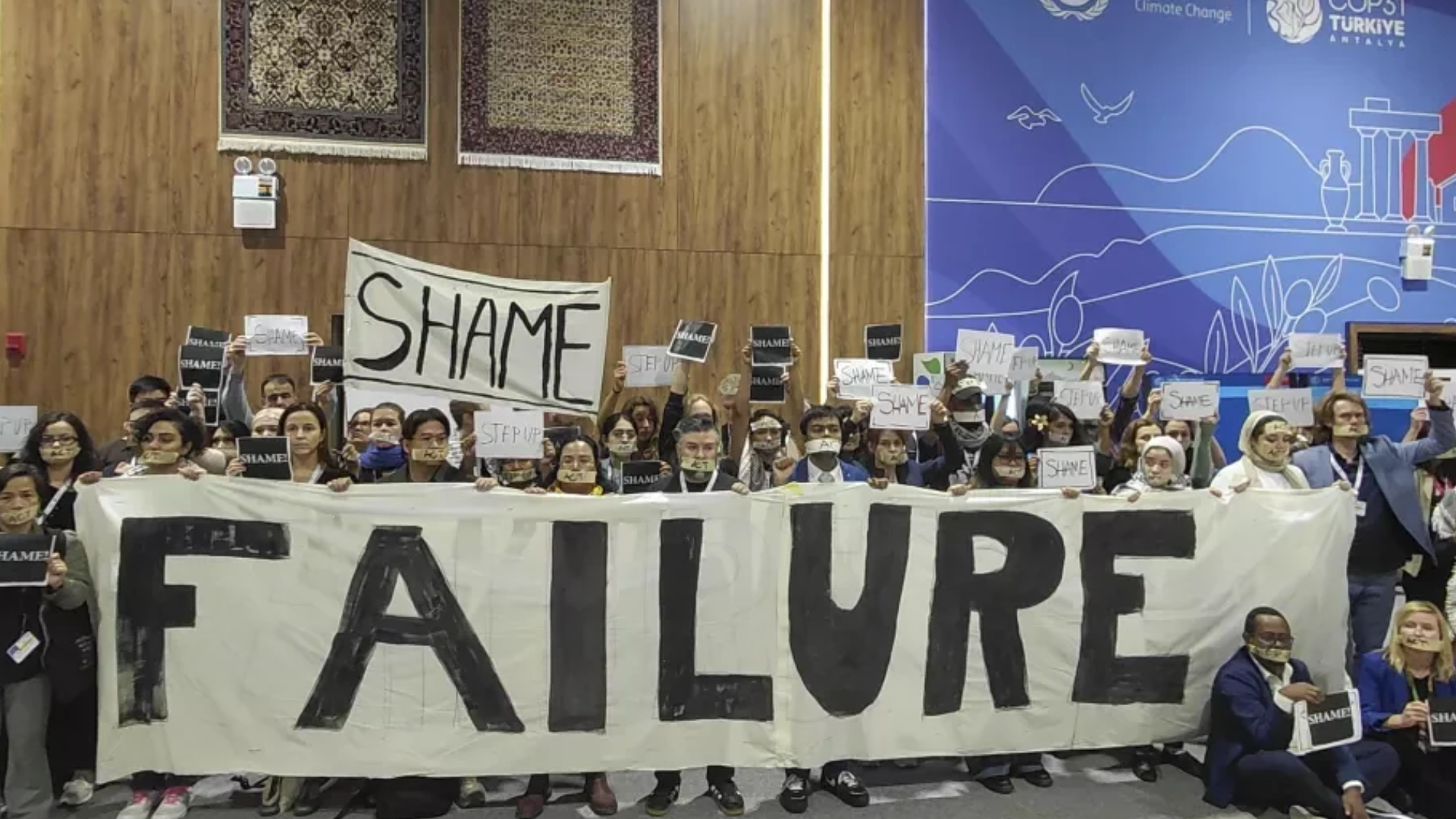
In light of the outcome of COP31 in 2026, held in Antalya, Turkey, under the joint presidency of Turkey and Australia, the international community once again shirked its historical responsibilities. For the first time since 2009, no agreement was reached among the parties after the final text removed any explicit reference to the need to phase out fossil fuels and deleted the $120 billion financing target. The final outcome is nothing more than global submission to the profits of large corporations and of the countries that enrich themselves by polluting, while millions of people are condemned to a future of droughts, floods and displacement.
COP31 closed without an agreement among the parties after a final draft that avoided naming the main cause of the climate crisis: fossil fuels. The initial draft, which included a call to accelerate the phase-out of coal, oil and gas, was replaced by a shorter version in which any mention of fossil fuels disappeared entirely. The final text was limited to a voluntary invitation to increase the share of electricity in global energy consumption to 35% by 2035, without specifying that this electricity must come from renewable sources. In other words: the target can be met by burning gas and coal. At the same time, the document gives unprecedented prominence to carbon capture, use and storage technologies (CCUS), a false “solution” that only serves to give the fossil industry an alibi to prolong its polluting business. Omitting the cause from the text completely rules out any kind of accountability, since there are no binding targets, no timetables and no financing obligations.
The final joint declaration was not approved. A group of countries, made up of EU states, small island states and several African and Latin American states, expressed their outright rejection of a document that explicitly ignores fossil fuels. In addition, the 44 poorest countries, which suffer the most devastating consequences, representing more than 1 billion people and barely 3.3% of global emissions, demanded a climate justice mechanism and lamented that their financing demands (more than $1 trillion) were ignored. This only proves that climate multilateralism is held hostage by the interests of the major polluters.
The West, and in particular the United States and the European Union, once again demonstrated that its climate rhetoric stops where binding commitments begin. The United States did not send an official delegation for the second consecutive year, while the EU, although it criticised the text for not explicitly referring to fossil fuels, resisted assuming new financial obligations, which in practice means continuing to walk towards the abyss. However, it was not only the West that showed an irresponsible position. China, the world’s largest emitter of GHG (17.4 billion tonnes of GHG) continues to bet on coal; Russia, the fourth largest GHG emitter, was the state that increased GHG the most in 2025; Australia is the world’s third largest exporter of fossil fuels; India, the current third largest emitter with 4.22 billion tonnes, keeps more than half of its electricity generation based on coal and plans to increase it; and, of course, Saudi Arabia continued to consolidate its historical leadership in obstructing climate negotiations.
On the other hand, according to the IMF, in 2024 fossil fuel subsidies reached $7.4 trillion. This contrasts with what poor countries receive, since of the $305 billion a year they need to adapt by 2035, they received only between $28 billion and $32 billion from international public sources in 2024. Thus, the large corporations and state economies that benefited historically (and that benefit today!) from the burning of fossil fuels continue to externalise the costs onto the most vulnerable.
The failure of COP31 is not an institutional abstraction, but the expression of a collective defeat. The United Nations Environment Programme (UNEP) concluded that the possibility of limiting warming to 1.5°C has already been completely lost. The presidency’s own draft acknowledges that, even if all national plans are met, the increase would be approximately 2.6°C. This translates into millions of people in Africa, South Asia, Latin America and small island states facing prolonged droughts, catastrophic floods, crop losses and forced displacement over the coming decades.
At the same time, the climate crisis is already causing a debt spiral in poor countries: natural disasters destroy infrastructure and livelihoods, while states must borrow at high interest rates to rebuild, which reduces their capacity to invest in adaptation and perpetuates their dependence. The multilateral system, already very weakened, emerges from this COP even more eroded, since the global agreement does not even name the cause of climate change and is geared towards protecting the interests of those who pollute.
However, the central consequence of the non-approval of a final joint declaration among the parties is the erosion of the democratic legitimacy of global climate governance. If anything became clear at this COP31, it is that a minority of oil-producing states, aligned with the major fossil corporations, can block any significant progress that might be made. It seems forcibly necessary to change the current consensus system, since de facto it becomes an instrument of veto by the polluters. Peoples (especially indigenous communities, peasants and coastal populations) are denied their right to decide on the territories they inhabit, so their sovereignty is directly attacked and doomed to a future where the climate is decided according to the interests of the extractive industry. Thus, the fight against climate change is also the fight for democracy, since without the capacity to control the decisions that affect the material conditions of life, democracy is reduced to a completely empty shell.
COP31 failed because the climate governance system is designed to protect the profits of large corporations and of the countries that enrich themselves by polluting. The fight against the climate emergency is inseparable from the fight against fossil capitalism, for the sovereignty of peoples and for real democracy. There is no possible just transition without a break with the capitalist system that subjects peoples entirely to the power of the large corporations that, at the same time, condemn us to the abyss.
Sources
-
Diario Público (2026). La COP31 va a la prórroga sin avances reales para que el planeta abandone los combustibles fósiles. https://www.publico.es/sociedad/m-ambiente/cop31-prorroga-avances-reales-planeta-abandone-combustibles-fosiles.html
-
Diario Público (2026). El abandono de los combustibles fósiles desaparece del nuevo borrador de la COP31. https://www.publico.es/sociedad/m-ambiente/abandono-combustibles-fosiles-desaparece-nuevo-borrador-cop31.html
-
ECOticias.com El Periódico Verde (2026). Greenpeace denuncia un borrador de la COP31 que da oxígeno a los fósiles y aplaza la financiación. https://www.ecoticias.com/cambio-climatico/borrador-de-la-cop31-greenpeace-fosiles
-
ECOticias.com El Periódico Verde (2026). Greenpeace en la COP31 denuncia un salvavidas para las petroleras y promesas vacías para el sur global. https://www.ecoticias.com/cambio-climatico/greenpeace-en-la-cop31-petroleras-financiacion
-
elDiario.es (2026). La Cumbre del Clima entra en la prórroga bajo amenazas de bloqueo. https://www.eldiario.es/sociedad/cumbre-clima-entra-prorroga-amenazas-bloqueo_1_13681073.html
-
elDiario.es (2026). La Cumbre del Clima se empantana rumbo a la segunda bola extra. https://www.eldiario.es/sociedad/cumbre-clima-empantana-rumbo-segunda-bola-extra_1_13683276.html
-
Noticias Obreras (2026). La Cumbre del Clima se atasca por la financiación y el abandono de los combustibles fósiles. https://noticiasobreras.es/2026/11/la-cumbre-del-clima-se-atasca-por-la-financiacion-y-el-abandono-de-los-combustibles-fosiles/
-
Noticias Obreras (2026). COP31: la transición justa y la financiación climática emergen como los grandes escollos de la cumbre de Antalya. https://noticiasobreras.es/2026/11/cop31-la-transicion-justa-y-la-financiacion-climatica-emergen-como-los-grandes-escollos-de-la-cumbre-de-antalya/
-
RTVE.es (2026). La nueva propuesta de acuerdo en la cumbre del clima elimina la mención a los combustibles fósiles. https://www.rtve.es/noticias/20261119/nueva-propuesta-acuerdo-cumbre-clima-elimina-mencion-combustibles-fosiles/17321529.shtml
-
RTVE.es (2026). La COP31 busca fuera de plazo llegar a un acuerdo climático en plena tensión por los hidrocarburos. https://www.rtve.es/noticias/20261121/cumbre-clima-cop31-acuerdo/17324678.shtml
-
RTVE.es (2026). Guterres alerta en la COP31 de que la crisis climática avanza más rápido que la respuesta mundial. https://www.rtve.es/noticias/20261111/guterres-alerta-cop31-crisis-climatica-avanza-rapido-respuesta-mundial/17309328.shtml
-
UN News (2026). COP31: Los combustibles fósiles quedan fuera del borrador del acuerdo. https://news.un.org/es/story/2026/11/1542194
-
UN News (2026). COP31:最新协议草案删去摆脱化石燃料相关表述. https://news.un.org/zh/story/2026/11/1143229
-
POLITICO (2026). EU climate chief hints bloc may drop clean power push at COP31. https://www.politico.eu/article/eu-climate-chief-wopke-hoekstra-hints-bloc-may-drop-clean-power-push-at-cop31/
-
Rebelion (2026). Los desacuerdos sobre la ‘regla 42’ y el consenso obligatorio lastran la Cumbre del Clima. https://rebelion.org/los-desacuerdos-sobre-la-regla-42-y-el-consenso-obligatorio-lastran-la-cumbre-del-clima-es-su-fuerza-y-su-debilidad/