The August 2026 disaster in Nepal, when a glacial lake collapsed on the border with Tibet, confirmed that anthropogenic climate change not only alters the atmosphere and the oceans, but also the Earth’s crust. Official UN figures recorded 157 dead and 245 missing, although local sources raised the toll to more than 1,270 dead. It was not an earthquake, but a “GLOF” (glacial lake outburst flood), a hydrogeological phenomenon triggered when ice retreat forms lakes dammed by unstable moraines.
This is not an isolated case. In September 2023, an avalanche of 25 million cubic metres of rock and ice rushed into “Dickson” Fjord, in Greenland, generating a 200-metre tsunami that made the Earth vibrate for nine days. In February 2021, another avalanche of 27 million cubic metres swept through the Chamoli valleys, in India, with more than 200 dead. In October 2023, “South Lhonak” Lake, in Sikkim, burst and released 50 million cubic metres of water that swept 385 kilometres down the valley.
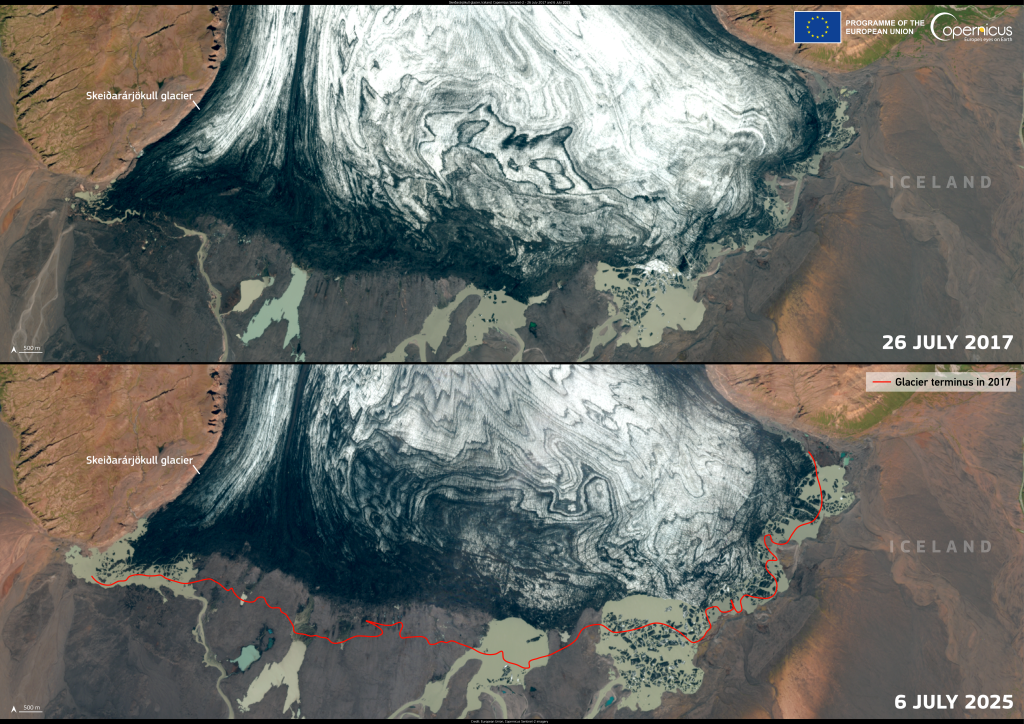
The connection goes beyond glacial lakes. In Iceland, the scientific community is investigating whether glacier retreat (they cover around 10% of the island) could increase volcanic eruptions by reducing pressure on magma chambers. In Alaska, the loss of more than 3,000 cubic kilometres of ice since 1770 increased “Coulomb” stress on the “Fairweather” Fault, the site of the magnitude 7.8 earthquake of 1958. Glacial isostatic adjustment modifies stresses in the crust and can modulate seismicity.
The evidence is solid regarding the mechanisms described, but it enters the realm of speculation when attempting to quantify future risk. IPCC AR6 projects that glaciers will lose between 18% and 36% of their mass between 2015 and 2100. Current “GLOF” models are insufficient because they do not adequately incorporate erosion, sediment transport and cascading processes. What is undeniable is that anthropogenic climate change is creating the conditions for these phenomena to occur with greater frequency and magnitude.
Sources
-
University of Oxford (2024): “A rockslide-generated tsunami in a Greenland fjord rang Earth for 9 days”. https://intelligent-earth.ox.ac.uk/publication/2023457/scopus
-
European Space Agency (2021): “Satellites reveal cause of Chamoli disaster”. https://www.esa.int/Applications/Observing_the_Earth/Satellites_reveal_cause_of_Chamoli_disaster
-
EurekAlert (2025): “Drivers, causes and impacts of the 2023 Sikkim flood in India”. https://www.eurekalert.org/news-releases/1071771
-
Deutsche Welle (2024): “Is climate change increasing Iceland’s volcanic activity?”. https://www.dw.com/en/is-climate-change-increasing-icelands-volcanic-activity/g-70648153
-
Rollins, C. et al. (2021): “Stress Promotion of the 1958 Mw∼7.8 Fairweather Fault Earthquake and Others in Southeast Alaska by Glacial Isostatic Adjustment and Inter-earthquake Stress Transfer”. https://agupubs.onlinelibrary.wiley.com/doi/10.1029/2020JB020411
-
IPCC AR6 WG2, Chapter 4 (Water). https://www.ipcc.ch/report/ar6/wg2/chapter/chapter-4/