
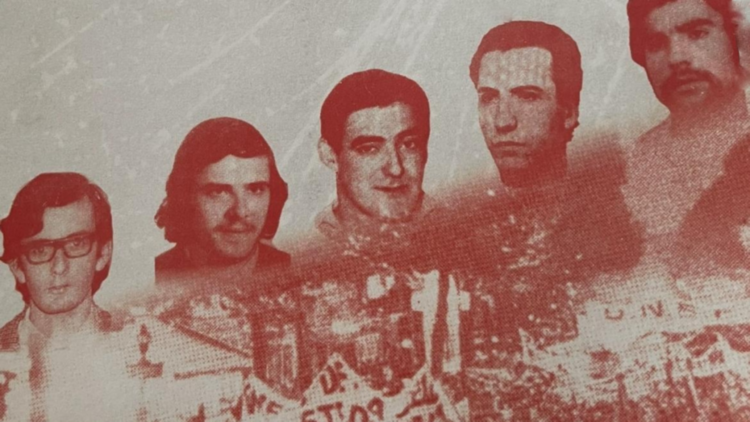
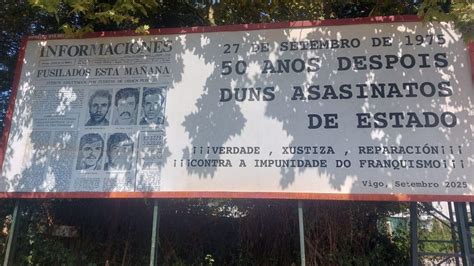
On 27 September 1975, as the Francoist dictatorship was in its death throes, the last five executions of the dictatorial regime were carried out. Among them was Xosé Humberto Baena Alonso, a 24-year-old from Vigo and a member of the FRAP (Frente Revolucionario Antifascista y Patriota). He was arrested and charged in a police setup, and tried by a summary court-martial that presented numerous irregularities. Defence evidence and witnesses were not admitted, the lawyers were expelled from the courtroom, and the sentence was based on self-incriminating statements obtained under torture. An observer from the International League for the Defence of Human Rights described the trial as a “sham” and a “sinister farce”.
The family never accepted the official version. His father appeared before the Military Court in Madrid with evidence proving his innocence, but the petition was dismissed. The documentation related to the defence was destroyed in a mysterious arson fire at his home. His sister, Flor, continued the legal battle for decades, appealing to the Constitutional Court, the European Court of Human Rights in Strasbourg and the UN, where she always received the same response: the Spanish State had not signed the relevant treaties at that time.
Today marks one year since, fifty years after the murder by the then government of the Spanish State, the current Government of the Spanish State delivered to the family the “Declaration of personal recognition and reparation“, a provision established in the 2022 Democratic Memory Law. Signed by the Minister of Territorial Policy and Democratic Memory, the declaration states that Baena “suffered persecution for political and ideological reasons during the Franco dictatorship”. It declares “illegal and illegitimate the court” that tried him, as well as “illegitimate and null the sentence” handed down against him. This recognition does not entail financial compensation, but it does constitute a moral reparation for his memory and for democracy.
The annulment of Baena’s sentence transcends the specific case. The five executions of 27 September 1975 sparked a wave of international protests and even a plea for clemency from Pope Paul VI. The poet Luis Eduardo Aute dedicated the song Al alba to them, which circumvented censorship and became an anthem against the death penalty.
While this step is fundamental, the struggle continues and many steps remain to be taken for memory, truth and justice. Only in this way is it possible to learn from history so as not to repeat it.
References:
-
Cadena SER (2025). Medio siglo después, el Gobierno anula la condena a muerte de Humberto Baena. https://cadenaser.com/galicia/2025/08/11/medio-siglo-despues-el-gobierno-anula-la-condena-a-muerte-de-humberto-baena-radio-vigo/
-
El Salto (2025). El Gobierno anula la condena a uno de los cinco últimos fusilados por el franquismo. https://www.elsaltodiario.com/memoria-historica/gobierno-anula-condena-uno-cinco-ultimos-fusilados-franquismo
-
El País (2025). El Gobierno declara nula la condena a muerte a Humberto Baena, uno de los últimos fusilados del franquismo. https://elpais.com/espana/2025-08-11/el-gobierno-declara-nula-la-condena-a-muerte-a-humberto-baena-uno-de-los-ultimos-fusilados-que-inspiro-la-cancion-al-alba.html
-
La Sexta (2025). El Gobierno declara “ilegítima y nula” la condena a Xosé Humberto Baena, el último fusilado del franquismo. https://www.lasexta.com/noticias/nacional/gobierno-declara-ilegitima-nula-condena-xose-humberto-baena-ultimo-fusilado-franquismo_202508116899d5926d08be7a8a4c69a4.html
-
Praza Pública (2025). 50 anos sen Humberto Baena, o mozo vigués que o franquismo asasinou co seu disparo final. https://praza.gal/acontece/50-anos-sen-humberto-baena-o-mozo-vigues-que-o-franquismo-asasinou-co-seu-disparo-final
-
La Voz de Galicia (2025). «Han hecho falta 50 años para que mi hermano pase de asesino a asesinado». https://www.lavozdegalicia.es/noticia/vigo/2025/08/24/falta-50-anos-hermano-pase-asesino-asesinado/0003_202508V24C8991.htm
-
EFE (2025). El Gobierno declara «ilegítima y nula» la condena al último fusilado del franquismo. https://efe.com/cataluna/2025-08-08/gobierno-declara-nula-condena-ultimo-fusilado-franquismo/