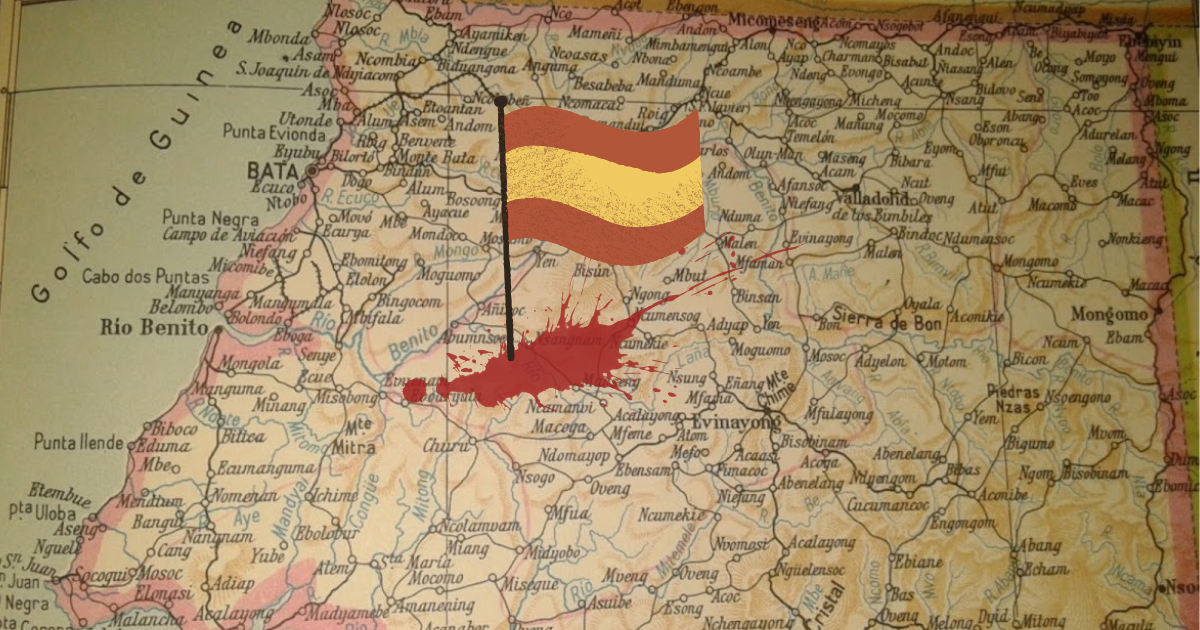
When people talk about Spanish colonialism, the first image that usually springs to mind is the Latin American continent. But there were also Spanish colonies in Africa that are rarely, if ever, mentioned: Western Sahara and Equatorial Guinea. This article will focus on the latter.
In the 18th century, Portugal ceded the islands of Fernando Poo (now Bioko) and Annobón to Spain, along with rights over the mainland coast between the Niger and Ogué rivers. Spain’s objective was one of slavery: to obtain more human beings to capture, enslave and send to the Americas.
But the British had similar interests and occupied much of the territory. For this reason, many authors consider the Spanish colonisation of Equatorial Guinea to have taken effect in 1900, when the Treaty of Paris established the colony’s boundaries.
A few decades later, to no one’s surprise, Franco imposed National Catholic authoritarianism on Guinea. Power was exercised by military governors who carried out systematic violence against the population, who were subjected to forced labour on cocoa, coffee and timber plantations. Furthermore, racial segregation and the imprisonment or disappearance of anyone showing any form of resistance were the order of the day. One example was the disappearance of the Fang independence leader Acacio Mañé at the hands of Franco’s forces in 1959. To this day, it is not known what happened to him.
On 12 October 1968, Equatorial Guinea’s attempt to gain independence from Spain failed. The date was chosen by Franco for its symbolism, and the new president was a carbon copy of the dictator: Francisco Macías Nguema was a nationalist leader who caused the death or exile of a third of the population after coming to power. Furthermore, the colonists encouraged separatism among the Bubi ethnic group to retain the island of Fernando Poo, provoking ethnic conflicts that persist to this day.
After 11 years of dictatorship, Nguema was overthrown in a coup and replaced by his nephew, Teodoro Obiang, who went on to further consolidate the authoritarian system. Today, the country remains trapped in an extractive model in which over 90% of GDP depends on oil.
Yet this history remains unknown to the Spanish public. Among the reasons for this is Carrero Blanco’s classification of information relating to Guinea as ‘classified’ between 1969 and 1977, a secrecy that extended to the education system. Furthermore, during the Spanish transition, a pact of silence was made that buried the memory of Guinea. It is high time to remember it and demand that the Spanish State face up to its historical responsibilities.