
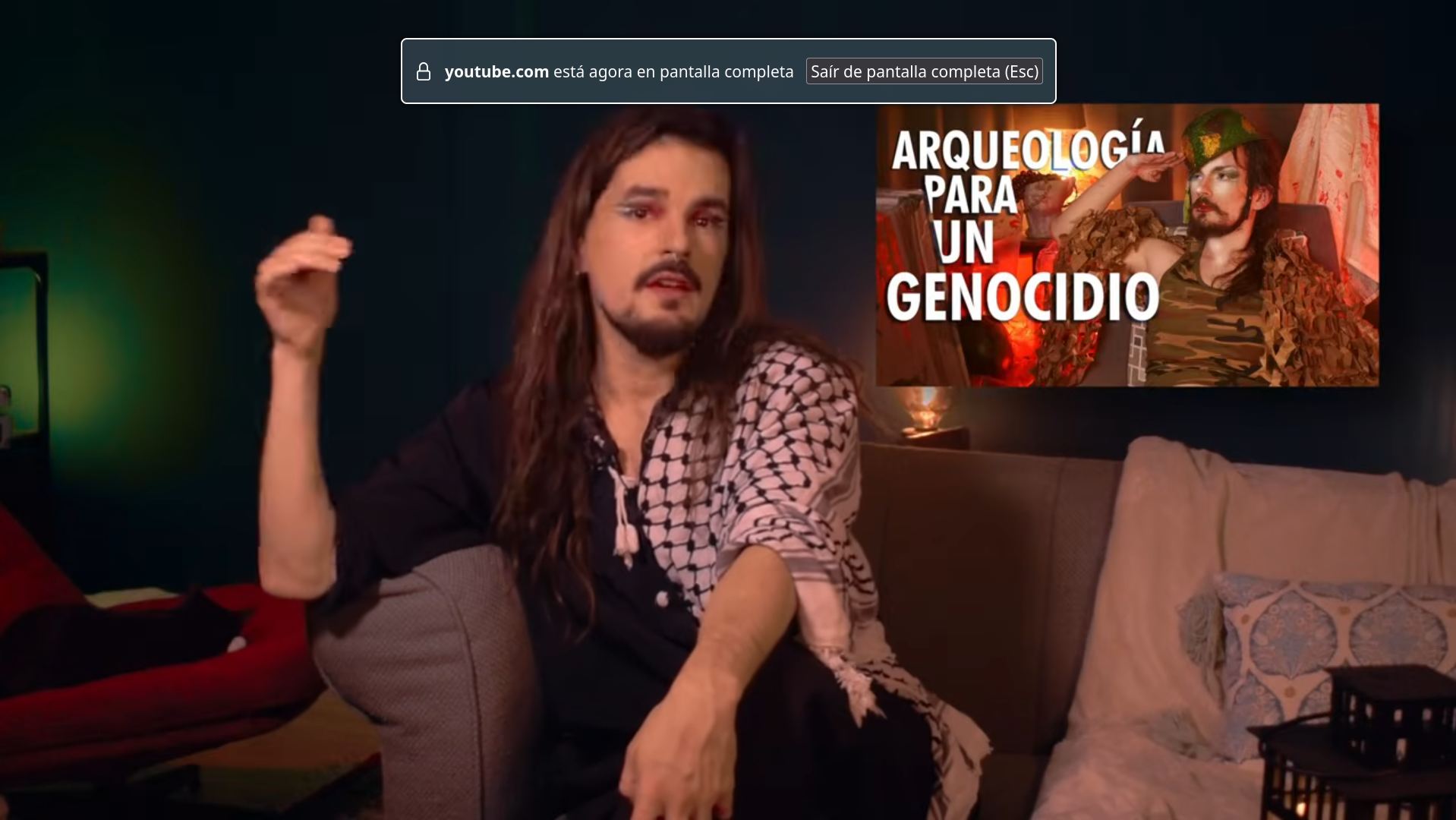
Western propaganda has built a hegemonic narrative about the legitimacy of Israel and its founding ideology. However, when historical facts are confronted with available data, the perspective can change radically. It is in this space of critical revision that archaeologist Mikel Herrán, known as “PutoMikel”, appears with a nearly three‑hour video that traces the history of Zionism from its origins to the present day. The piece, published on December 28, 2025, has sparked intense debate by proposing a reading that questions the very foundations of the official account, always with a deliberately ironic and extravagant tone that characterises the communicator.
The video’s content is structured as a chronological journey that debunks the main myths of Zionism. Herrán, a PhD in Archaeology and holder of a master’s degree in Archaeology of the Arab and Islamic World, uses documentary and academic sources to point out the contradictions between the Zionist narrative and historical reality. Among the issues he addresses are the alleged peaceful nature of Jewish immigration to Palestine, the instrumentalisation of the Holocaust as a political justification, and the initial ties of Zionism with colonial powers and even with fascism. The video also explores the relationship between Zionism and antisemitism, a connection that Herrán describes as an “uncomfortable friendship” in the movement’s early years.
The official narrative, as defined by the World Zionist Organisation, presents this movement as the “national liberation movement of the Jewish people”, and places its birth at the First Zionist Congress in Basel (1897) convened by Theodor Herzl. However, since the 1980s, a group of Israeli historians known as the “New Historians” (Benny Morris, Ilan Pappé, Avi Shlaim) have called that version into question. Documentary sources, including Israeli military archives, indicate that around 800,000 Palestinians were forcibly displaced and some 500 villages razed during the 1948 war – data that contradict the thesis of a “voluntary exodus” upheld by the Hebrew State for decades.
The work of “PutoMikel” belongs to a critical current that the author himself frames within decolonial archaeology. His central thesis, also presented in other forums such as the podcast “Carne Cruda”, is that Zionism is not a liberation movement but a colonialist project that erected racism into state ideology – a qualification that had already appeared in UN documents in the 1970s. The piece’s impact, with over 150,000 interactions on social media, evidences the growing interest in revisiting the historical foundations of the conflict, while official historiography insists on the need for a “Jewish and democratic state”. The debate, far from being closed, opens new questions about the deliberate manipulation of archaeology and history in legitimising current policies.
Sources:
-
Organización Sionista Mundial (s.d.). https://www.wzo.org.il/
-
Nacións Unidas (s.d.). Cronoloxía da cuestión de Palestina. https://www.un.org/unispal/history/
-
BBC Mundo (2021). Breve historia de Israel. https://www.bbc.co.uk/spanish/specials/1019_israel/index.shtml
-
Amnistía Internacional (2021). Oito claves para entender o conflito palestino-israelense. https://www.amnesty.org/en/location/middle-east-and-north-africa/middle-east/israel-and-the-occupied-palestinian-territory/report-israel-and-the-occupied-palestinian-territory/
-
RTVE (entrevista a Ilan Pappé). https://www.rtve.es/noticias/20241119/ilan-pappe-antisemitismo-arma-israel-acallar-criticas/16335890.shtml